BSocSc Psychology

Subtitle
社會科學學士(心理學)
Thumbnail
Image
JS1112_1298A_20250331
Academic Year of Entry
Admission Code

1298A

Indicative Intake Target

Local Places:

26 (For First Year and Advanced Standing I Entries; Tentative)* and 
30 (For Senior Year Entry)


Non-Local Places  
(All CityUHK programmes except Mainland Gaokao):

Around 500

Normal Duration of Programme
3 Years (For Advanced Standing I Entry)
2 Years (For Senior Year Entry)
Major Leader
Prof. LAI Chuk Ling Julian
Remarks

* for JUPAS and non-JUPAS admissions (quota is subject to approval)

Why BSocSc Psychology?

The Psychology major provides students with comprehensive training in psychology with an emphasis on experimental and research competencies, and prepares students for professional development in human service careers and advanced training in professional psychology and related fields.

Our programme provides:

  • Strong theoretical & scientific training in psychological studies to equip all graduates with essential skills and knowledge to conduct research and to apply learning to daily life
  • Individual research project in the final year to work with a faculty
  • Lab-based training in eye-tracking system, EEG system, and Visual Reality System
  • Opportunities for summer local and oversea internships to explore career interests and develop future careers
  • Opportunities for oversea exchanges to enhance cross-cultural understanding
  • Opportunities to work on empirical research led by academic staff (e.g., voluntary research schemes)

Within this programme, students can: 

  • Opt for either stream of specialization in Health & Development or Mind & Brain    

After graduation, students are eligible: 

  • To apply for graduate membership of professional associations in Hong Kong Psychological Society (HKPS), British Psychological Society (BPS), and American Psychological Association (APA)
  • To pursue advanced training in Master’s or Doctoral level degrees in research & applied psychology, Clinical Psychology, Educational Psychology, Counselling Psychology, and Industrial & Organizational Psychology in local and overseas universities.
Entrance Requirements for Direct/Non-JUPAS Applicants

Entrance Requirements for Direct/Non-JUPAS Applicants

To be considered for admission, you must satisfy the General Entrance Requirements.

For senior-year (Advanced Standing II) admission, applicants are normally expected to have completed an Associate Degree/Higher Diploma with a Cumulative Grade Point Average (CGPA) of ≥3.0 or an equivalent overall mark, or a credit award.

Potential applicants will be required to submit a portfolio containing personal credentials.

Curriculum Structure

For details of the programme’s curriculum structure, please visit the ‘Undergraduate Catalogue’.

What You Will Be Studying

Core Courses:

• Basic Psychology  
• Basic Psychology II  
• Research Methods for Behavioural Sciences  
• Developmental Psychology  
• Personality and Individual Differences  
• Design and Analysis for Psychological Research I and II  
• Biological Psychology  
• Cognitive Psychology  
• Learning and Behaviour  
• Social Psychology  
• Final-Year Research Project

Electives:

• Psychology of Interpersonal Relations  
• Psychological Testing  
• Psychology of Childhood and Adolescence  
• Multivariate Analysis for Psychological Research  
• Cultural Psychology  
• Neuropsychology  
• Abnormal Psychology  
• Psychology of Ageing  
• Psychology of Language  
• Positive Psychology  
• Cognitive Neuroscience  
• Designing Experiments in Psychology  
• Counselling & Therapeutic Psychology  
• Introduction to Health Psychology  
• Introduction to Educational Psychology  
• Introduction to Industrial and Organizational Psychology 
• Psychology Internship

(Note: The list of elective courses offered may vary from year to year.)


Start Your Career Here

Our graduates are particularly suited for people-oriented jobs such as human resources, public relations, customer services, children and youth services, education and training, counselling and guidance, health-related services, family and community work, etc.  Students are also well-prepared for jobs that require strong research skills and competence, critical analysis and communication abilities, such as scientific or applied research, research and development, project management and so on. Students who aspire to practice as professional psychologists will be able to pursue advanced education at the Master's or doctoral level in Hong Kong or overseas with training in pursuing scientific research or applied psychological training such as health, forensic, clinical, educational, counselling and occupational psychology.

Professional Recognition

Graduates who satisfy the requirements stipulated by the Hong Kong Psychological Society (HKPS) can apply for Graduate Membership of the Society (Note: Graduate Membership of the HKPS is normally regarded as an entrance requirement for advanced training in professional psychology).

Features
  • Practical learning in psychology laboratories.
  • Opportunities to engage in summer internships in or outside Hong Kong.
  • Individual supervision for the Final Year Project.
  • Interdisciplinary learning in other social sciences, such as sociology, social work, counselling, and crime science.
  • Exchange programmes with overseas universities. 
Programme Video
Contact Type
Email
Contact Value
Programe A-Z
Title (For sorting)
537
Non-JUPAS Year 1 Admission
Non-JUPAS Senior Year Admission
International Admission
Mainland Non-Gaokao Admission
Deadline applicable to all types of Admission
Interview Arrangement - Direct SY

Not required

Late Application (Deadline applicable to all types)
Off
Late Application (International Admission)
Off
Late Application (Mainland Non-Gaokao Admission)
Off
Late Application (Non-JUPAS Senior Year Admission)
Off
Late Application (Non-JUPAS Year 1 Admission)
Off
Maths Core / M1 / M2 Calculation as one Subject
Off
Historical Data Display
Off
Reduce the font size?
Off

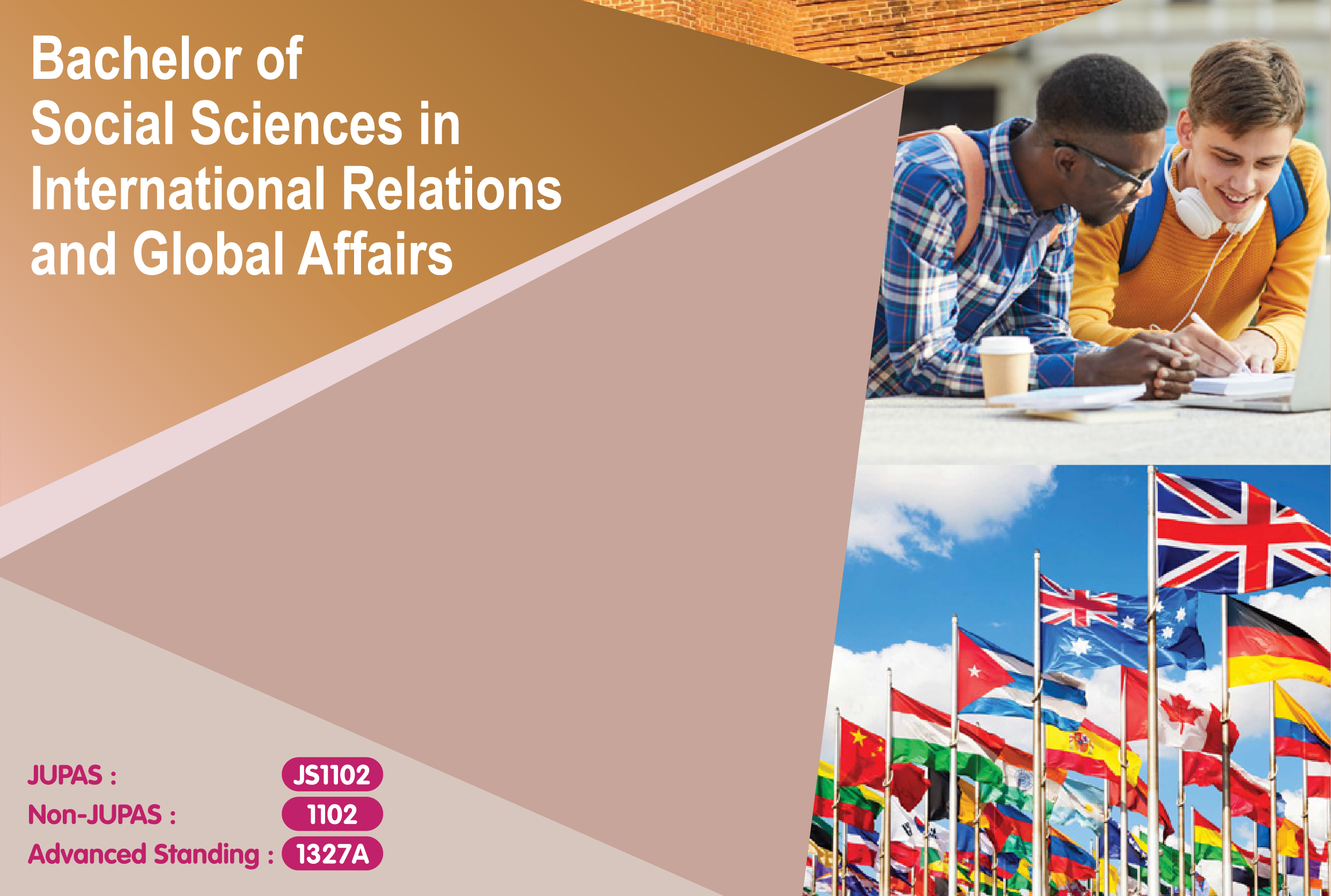
BSocSc International Relations and Global Affairs
Subtitle
社會科學學士(國際關係及全球事務)
Thumbnail
Image
Programme leaflet
Academic Year of Entry
Admission Code

1327A

Indicative Intake Target

Local Places:

20 (For First Year and Advanced Standing I Entries)* 


Non-Local Places  
(All CityUHK programmes except Mainland Gaokao):

Around 500

Normal Duration of Programme
3 Years (For Advanced Standing I Entry)
Admissions Tutor
Prof. Yuk Wah CHAN
Programme Leader
Prof. Federico FERRARA
Remarks

* for JUPAS and non-JUPAS admissions

Why BSocSc International Relations and Global Affairs?

This major is the first and only program in Hong Kong to focus on the increasingly important Asian region in this Asian age.

It strengthens students’ international perspectives.

It is staffed by scholars conducting field-based research in Asian countries and provides students with up-to-date and in-depth regional knowledge.

It features opportunities for students to join overseas exchange programs and field trips to different countries in and beyond Asia to broaden their horizons.

PIA’s internship program offers on-site job training in a number of fields, such as non-government organizations, marketing and research firms, private companies, media sectors, political parties and policy consultancy agencies.

Entrance Requirements for Direct/Non-JUPAS Applicants

Entrance Requirements for Direct/Non-JUPAS Applicants

To be considered for admission, you must satisfy the General Entrance Requirements.

Curriculum Structure

For details of the program’s curriculum structure, please visit the Undergraduate Catalogue.

Department of Public International Affairs

The Department of Public and International Affairs is a multidisciplinary department with a multinational faculty and a strong international orientation. With faculty members graduating from many of the world’s top universities and with a commitment to leading edge research and high quality teaching, the Department can lay a strong claim to be the leading department in its field in the region.

Our Target

This major explores Asia’s significance in contemporary world politics and Hong Kong’s strategic positions within China, Asia and the world. It aims to develop students’ knowledge of the socio-political, economic and cultural changes occurring in Asian countries and to situate them in the broader international context. Students will learn to contemplate Asia's increasingly significant roles in world affairs and examine these roles with both theoretical and practical analytical tools. Through its interdisciplinary curriculum and social research training, the major seeks to equip students with analytical skills that are of great value to organizations in different administrative and economic sectors throughout Hong Kong, Asia and beyond. In addition, it enhances students’ critical reasoning and problem-solving skills, and will deepen their regional and global perspectives.

What You Will Be Studying

This major emphasises good knowledge and analytical skills in local, regional and global issues and training to enhance students' oral and written skills. It offers both theoretical thinking and practical analytical perspectives.

Core components

  • Courses on the foundations of social sciences
  • Courses on social research methods
  • Courses on Asian societies
  • Courses on international and development studies
  • Courses on environment and globalization

The major offers three specialized streams: Asian Studies, International Studies and Development Studies. Students are encouraged to choose electives based on their interests. Elective courses include HK and China studies, specific regional, international and development topics, problem-based studies, migration issues and youth politics. All courses strengthen students’ practical skills and analytical abilities.

Start Your Career Here

This major aims to develop vital human resources that are of strategic importance to Hong Kong. It will develop your knowledge and skills, and broaden and deepen your international and regional perspectives to prepare you for a career in government, social and commercial sectors. Graduates are employable in a wide variety of occupational fields, including social research, market research, journalism and mass media, political groups, public relations, commerce, project-planning and management, social enterprises and non-government organizations.

Did You Know?

Our graduates have obtained jobs in teaching positions at all levels, as well as jobs in the private sector, such as editors, non-governmental organization workers, journalists, public-relations personnel, researchers, management trainees, etc.

Programme Video
Programme Brochure
Contact Type
Email
Contact Value
Programe A-Z
Title (For sorting)
543
Non-JUPAS Year 1 Admission
Non-JUPAS Senior Year Admission
International Admission
Mainland Non-Gaokao Admission
Deadline applicable to all types of Admission
Interview Arrangement - Direct SY

When necessary

Late Application (Deadline applicable to all types)
Off
Late Application (International Admission)
Off
Late Application (Mainland Non-Gaokao Admission)
Off
Late Application (Non-JUPAS Senior Year Admission)
Off
Late Application (Non-JUPAS Year 1 Admission)
Off
Maths Core / M1 / M2 Calculation as one Subject
Off
Historical Data Display
Off
Reduce the font size?
Off

BSocSc Public Affairs and Management

Subtitle
社會科學學士(公共事務與管理)
Thumbnail
Image
programme default img
Academic Year of Entry
Admission Code

1276A

Indicative Intake Target

Local Places:

63 (For First Year and Advanced Standing I Entries)* and 
110 (For Senior Year Entry)


Non-Local Places  
(All CityUHK programmes except Mainland Gaokao):

Around 500

Normal Duration of Programme
3 Years (For Advanced Standing I Entry)
2 Years (For Senior Year Entry)
Programme Leader
Professor Bart WISSINK

MUP, MPA, PhD (University of Amsterdam)

Why BSocSc Public Affairs and Management?

Make a difference: Study Public Affairs and Management (PAFM) at CityUHK

  • How do particular public policies emerge?
  • Who make(s) the decisions and why?
  • What are the roles of different stakeholders in public policy making?
  • Why are public policies so important and how do they impact our everyday lives?
  • What can we learn from other societies in relation to government and governance?
  • What are the key ethical issues in public policy?

PAFM will give you the essential analytical, communication, and leadership skills to prepare you for a successful career in a wide range of public, private and nonprofit sector jobs. Substantial training and practical opportunities will be provided in various learning modes to build your professional skills, competence and confidence.

Entrance Requirements for Direct/Non-JUPAS Applicants

Entrance Requirements for Direct/Non-JUPAS Applicants

To be considered for admission, you must satisfy the General Entrance Requirements.

For senior-year (Advanced Standing II) admission, applicants are normally expected to have completed an Associate Degree/Higher Diploma with a Cumulative Grade Point Average (CGPA) of ≥3.0 or an equivalent overall mark, or a credit award.

Curriculum Structure

For details of the programme’s curriculum structure, please visit the ‘Undergraduate Catalogue’.

Department of Public and International Affairs

The Department of Public and International Affairs is a multidisciplinary department with a multinational faculty and a strong international orientation. With faculty members graduating from many of the world’s top universities and with a commitment to leading edge research and high-quality teaching, the Department can lay a strong claim to be the leading department in its field in the region. For ranking and statistics, please see: https://www.cityu.edu.hk/pia/page.aspx?p=Ranking 

Our Target

The aims of the major in Public Affairs and Management (PAFM) are to:

  • provide students with a comprehensive education in the common core theories, concepts, and knowledge bases of public policy, public management, as well as housing and urban studies;
  • enable students to specialise in public policy,  public management, or housing and urban studies for gaining an understanding of the essential theories, principles, dynamics, and analytic approaches of these bodies of knowledge;
  • equip students with the theoretical, conceptual and analytical tools to understand comprehensively public policy, public management, and societal developments in Hong Kong, China and the contemporary global world; and
  • produce graduates who can meet effectively the human resources needs of a wide range of public and private sector employers in administrative, management, and policy analysis positions, as well as in the media and non-governmental organisations.
What You Will Be Studying

You will specialise in one of the following streams:

  • Political Affairs and Governance
  • Public Policy and Management 

The Political Affairs and Governance stream will engage students in the study of wider public affairs and governance issues. The Department can effectively broaden students’ horizons, boost their analytical and governance skills, and eventually improve their general employability.

The Public Policy and Management stream focuses on human resources management, financial resources management, organisational behavior in public management, management ethics, public policy ethics, and housing studies. Students of this stream may choose to specialize in “Housing Concentration” and may be eligible to become professional property management practitioners (Tier 1) licensed under the Property Management Services Ordinance.

A number of electives will also be offered to PAFM students to enrich their learning in the subject discipline.

Start Your Career Here

We are proud to say that our PAFM graduates have been highly successful in the job market, with many of them employable in a wide variety of occupational fields, including government, social and market research, journalism, public relations, commerce, finance, project-planning and management, and social enterprises. Please refer to the diagram for more information on the employment sectors of graduates of our Department in 2022 and 2023.

Did You Know?

The PAFM Major equips graduates for successful careers in a wide range of administration, management and policy positions in the public, private and nonprofit sectors.  PAFM graduates work as administrative officers and executive officers in various government departments.   Some also work as administrators and managers in public organisations such as universities, public hospitals, Housing Authority, Hospital Authority, and Airport Authority.  Some teach in secondary school and some have gone on to work as anchors and reporters in the news media.  Many of our graduates find employment in the private sector in the fields of public transport, banking, financial services, and property management. PAFM graduates also work in the nonprofit sector and social enterprises, involving in community, social and personal services.

Alumni Sharing
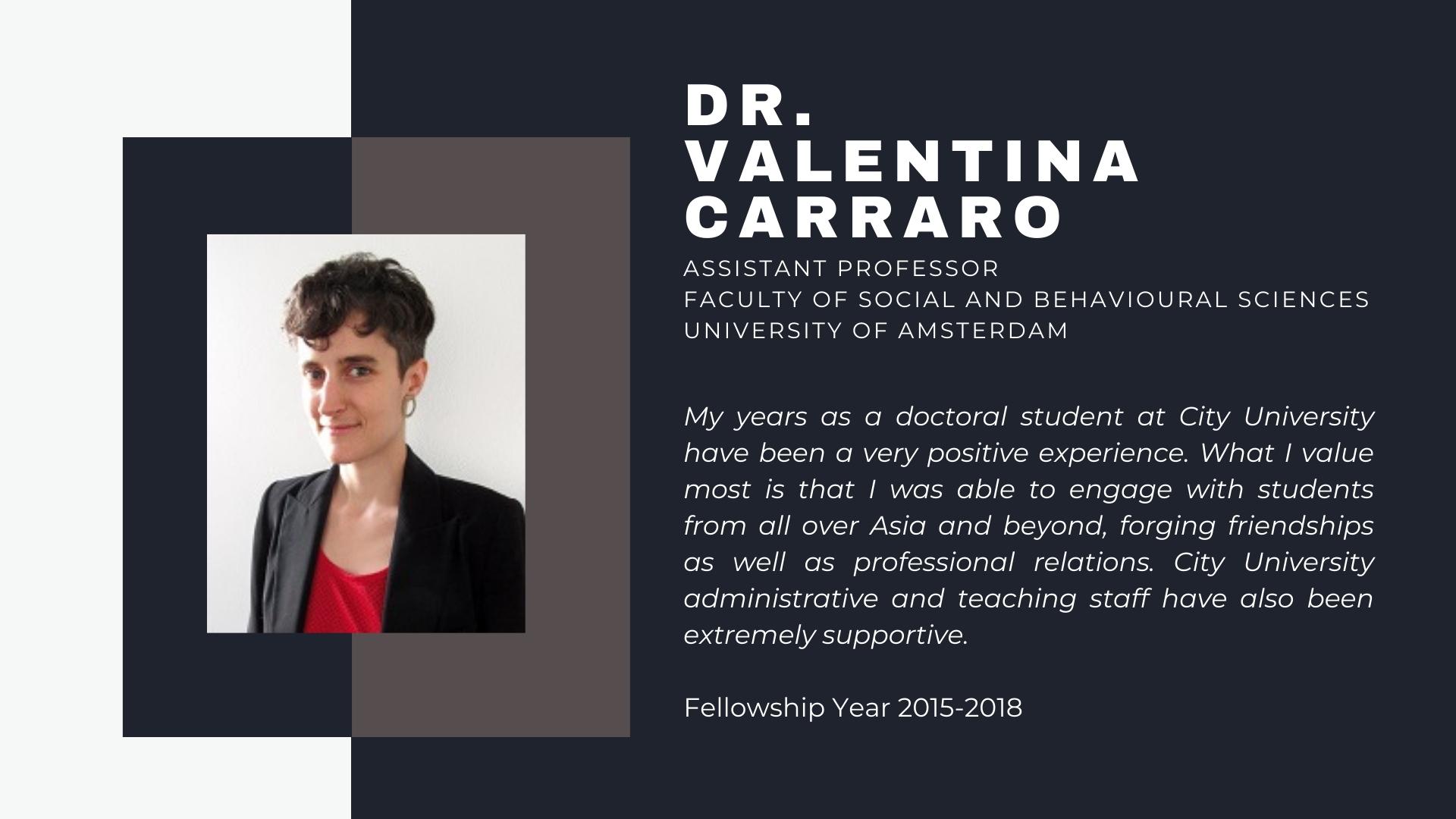
Valentina


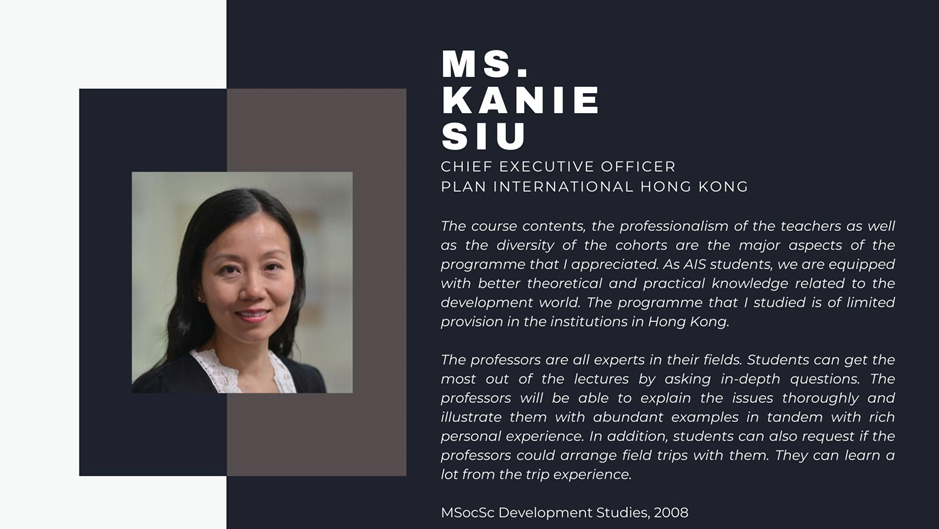
Kanie
Student Exchange/Internship

The Department of Public and International Affairs sends a large number of PAFM students to overseas universities in Europe, Australia, United States, Canada, and Asia for exchange study. The Department has achieved an impressive record in securing of international exchange places with universities in Europe, North America and Australia. The Department also provides internship to PAFM students to gain practical working experience in a wide range of public, private and nonprofit organizations. This helps the career planning of PAFM students. Apart from these, PIA summer schools are very popular among PAFM students for spending a summer in a foreign setting. Various field trips and study tours to different places are organized by faculty in different courses to broaden the horizons of PAFM students to enable them to compare and evaluate the practices of public policy and the operation of government in different countries.

For more details, please click here.

About Dept of Public and International Affairs
Programme Brochure
Contact Type
Email
Contact Value
Programe A-Z
Title (For sorting)
534
Non-JUPAS Year 1 Admission
Non-JUPAS Senior Year Admission
International Admission
Mainland Non-Gaokao Admission
Deadline applicable to all types of Admission
Interview Arrangement - Direct SY

Not required

Late Application (Deadline applicable to all types)
Off
Late Application (International Admission)
Off
Late Application (Mainland Non-Gaokao Admission)
Off
Late Application (Non-JUPAS Senior Year Admission)
Off
Late Application (Non-JUPAS Year 1 Admission)
Off
Maths Core / M1 / M2 Calculation as one Subject
Off
Historical Data Display
Off
Reduce the font size?
Off

BA Digital Television and Broadcasting

Subtitle
文學士(數碼電視與廣播)
Thumbnail
Image
programme default img
Academic Year of Entry
Admission Code

1356A

Indicative Intake Target

Local Places:

45 (For First Year and Advanced Standing I Entries)* and 
20 (For Senior Year Entry)


Non-Local Places  
(All CityUHK programmes except Mainland Gaokao):

Around 500

Normal Duration of Programme
3 Years (For Advanced Standing I Entry)
2 Years (For Senior Year Entry)
Programme Leader
Prof. KIM Ki Joon
Remarks

* for JUPAS and non-JUPAS admissions

Why BA Digital Television and Broadcasting?

The Department offers a range of innovative degree programmes designed to train versatile professional communicators for the age of media convergence and information integration. Graduates are well positioned for diverse careers in the media industry and communication sectors in businesses and government organizations.

Entrance Requirements for Direct/Non-JUPAS Applicants

Entrance Requirements for Direct/Non-JUPAS Applicants

To be considered for admission, you must satisfy the General Entrance Requirements.

For senior-year (Advanced Standing II) admission, applicants are normally expected to have completed an Associate Degree/Higher Diploma with a cumulative grade point average (CGPA) of ≥3.0 or an equivalent overall mark, or a credit award.

Curriculum Structure

For details of the programme’s curriculum structure, please visit the ‘Undergraduate Catalogue’.

Our Target

The B.A. Programme in Digital Television and Broadcasting (BATVB) aims to train students to be professionals in the digital new media industry. It puts students at the forefront of new media technology and enables them to learn a broad range of digital media skills, concepts, content, forms, trends and terminologies. It develops and extends students’ creative potential and nurtures their entrepreneurial expertise in such a way that encourages them to explore, discover and present unique peculiarities of social realities. It prepares graduates to take up the creative media, innovative, technological and management roles in the ever-changing media sectors in Hong Kong and elsewhere.

What You Will Be Studying

Please click here for details.

Start Your Career Here

This major trains students to be internationally oriented professionals with the knowledge and integrated skills to succeed in the media and communication sectors, particularly the rapidly expanding digital television and broadcasting industry, the advertising and marketing industry, the telecommunications industry and the content and creative sector of the IT industry. Graduates are well positioned to entering a wide range of careers in these industries.

Programme Video
Programme Brochure
Programme Brochure
Contact Type
Email
Contact Value
Contact Type
Phone
Contact Value

3442 8677

Programe A-Z
Title (For sorting)
549
Non-JUPAS Year 1 Admission
Non-JUPAS Senior Year Admission
International Admission
Mainland Non-Gaokao Admission
Deadline applicable to all types of Admission
Interview Arrangement - Direct SY

Not required

Late Application (Deadline applicable to all types)
Off
Late Application (International Admission)
Off
Late Application (Mainland Non-Gaokao Admission)
Off
Late Application (Non-JUPAS Senior Year Admission)
Off
Late Application (Non-JUPAS Year 1 Admission)
Off
Maths Core / M1 / M2 Calculation as one Subject
Off
Historical Data Display
Off
Reduce the font size?
Off

BA Media and Communication

Subtitle
文學士(媒體與傳播)
Thumbnail
Image
programme default img
Academic Year of Entry
Admission Code

1341A

Indicative Intake Target

Local Places:

45 (For First Year and Advanced Standing I Entries)* and 
30 (For Senior Year Entry)


Non-Local Places  
(All CityUHK programmes except Mainland Gaokao):

Around 500

Normal Duration of Programme
3 Years (For Advanced Standing I Entry)
2 Years (For Senior Year Entry)
Programme Leader
Prof. HUANG Guanxiong
Remarks

* for JUPAS and non-JUPAS admissions

Why BA Media and Communication?

The Department offers a range of innovative degree programmes designed to train versatile professional communicators for the age of media convergence and information integration. Graduates are well positioned for diverse careers in the media industry and communication sectors in businesses and government organizations.

Entrance Requirements for Direct/Non-JUPAS Applicants

Entrance Requirements for Direct/Non-JUPAS Applicants

To be considered for admission, you must satisfy the General Entrance Requirements.

For senior-year (Advanced Standing II) admission, applicants should have completed an Associate Degree/Higher Diploma with a cumulative grade point average (CGPA) of ≥3.0 or an equivalent overall mark, or a credit award, AND to have attained at least Level 3 or above in HKDSE English Language and Chinese Language or an equivalent qualification.

Curriculum Structure

For details of the programme’s curriculum structure, please visit the ‘Undergraduate Catalogue’.

Our Target

This major aims to provide students with current knowledge of theories and practices of media and communication from an interdisciplinary perspective. It seeks to develop students' critical and creative abilities in discovering and understanding the processes and structure of media and communication in their daily lives. By comparing and contrasting real-world examples, students will be able to apply the relevant theories and appropriate methods to analyse the interplay between media and society in various contexts and at different levels. The integrated curriculum is also designed to provide opportunities and platforms for students to explore their potential as well-rounded professional in media-related fields.

What You Will Be Studying

Please click here for details.

Start Your Career Here

This major prepares students to become internationally oriented professionals with a broad knowledge of and integrated skills in media and communication industries, including advertising and public relations, multimedia publishing and journalism and creative information technology. Graduates are well positioned to pursue diverse careers in various public and private sectors.

Programme Video
Programme Brochure
Programme Brochure
Contact Type
Email
Contact Value
Contact Type
Phone
Contact Value

3442 8677

Programe A-Z
Title (For sorting)
546
Non-JUPAS Year 1 Admission
Non-JUPAS Senior Year Admission
International Admission
Mainland Non-Gaokao Admission
Deadline applicable to all types of Admission
Interview Arrangement - Direct SY

Not required

Late Application (Deadline applicable to all types)
Off
Late Application (International Admission)
Off
Late Application (Mainland Non-Gaokao Admission)
Off
Late Application (Non-JUPAS Senior Year Admission)
Off
Late Application (Non-JUPAS Year 1 Admission)
Off
Maths Core / M1 / M2 Calculation as one Subject
Off
Historical Data Display
Off
Reduce the font size?
Off

BA Linguistics and Language Applications

Subtitle
文學士(語言學及語言應用)
Thumbnail
Image
BA Linguistics and Language Applications
Academic Year of Entry
Admission Code

1236A

Indicative Intake Target

Local Places:

25 (For First Year and Advanced Standing I Entries)* and 
38 (For Senior Year Entry)


Non-Local Places  
(All CityUHK programmes except Mainland Gaokao):

Around 500

Normal Duration of Programme
3 Years (For Advanced Standing I Entry)
2 Years (For Senior Year Entry)
Major Leader of BALLA
Prof. John S.Y. LEE

Associate Professor, Department of Linguistics and Translation

Admission Tutor of BALLA
Prof. Vanti W.S. LEE

Associate Professor, Department of Linguistics and Translation

For non-JUPAS admissions

Why BA Linguistics and Language Applications (LLA)?

Language is a defining aspect of humanity, shaping how we communicate, think, and connect. The Major in Linguistics and Language Applications (BALLA) explores the science of language, from constructing sentences and words to understanding how our brains process language, how language change over time, and how they reflect social and cultural identities. It also examines how adults, children, and even computers learn languages.

Studying linguistics offers practical applications with societal impact. Linguistics contribute to language education policies, address language-related social issues, develop AI-driven language technologies, and support those with speech or communication challenges. The Major in BALLA aims to educate students so that they will become language professionals who are familiar with linguistics and language-related applications. Along the way, students will develop an analytical, critical and creative mind and an open attitude towards people from different cultures. Students will also improve their communication and writing skills, making language learning more efficient and everyday interactions more effective.

Entrance Requirements for Direct/Non-JUPAS Applicants

Entrance Requirements for Direct/Non-JUPAS Applicants

To be considered for admission, you must satisfy the General Entrance Requirements.

For senior-year (Advanced Standing II) admission, applicants are normally expected to have completed an Associate Degree/Higher Diploma with a cumulative grade point average (CGPA) of ≥3.0 or an equivalent overall mark, or a credit award.
 

What You Will Be Studying?

There are two main subject areas: Linguistics and Language Applications.

  • Core courses in Linguistics include: Fundamentals of Linguistics, Introduction to Linguistic Research, Language in Society, Language and Mind, Phonetics, Phonology, Morphology and Syntax, and Semantics and Pragmatics.
  • Core courses in Language Applications include: Introduction to Language Technology, Computational Linguistics, and Project I.

At a more advanced level, students may choose from among courses such as Computational Lexicography, Computer-Assisted Language Learning, Conversation Analysis, Corpus Linguistics, Experimental Phonetics, First/Second Language Acquisition, Psycholinguistics, Sociolinguistics, and Project II.

Curriculum Structure

To find more details about the Programme Curriculum, please refer to the Programme Structure.

Bonus Features

1. Participating in internships and other co-curricular activities offered provides students valuable job experience in fields that require knowledge of languages, linguistics, and language applications.

2. Exchange programmes provide students with opportunities to gain experience of studying and living abroad for a semester, by paying the local tuition fees.

Start Your Career Here

This major provides students with a solid foundation in the scientific study of human language. Students will be prepared for careers that require language expertise and language-related computing skills. In addition to opportunities in advanced studies, graduates will have employment prospects in education and research as well as in administrative and executive positions in various public and private sectors. They will have an important role to play in language and information service sectors of Hong Kong, Greater China, and the world. Moreover, this major is recognized by the Education Bureau as an English language major degree for the purpose of teaching in Hong Kong (To be confirmed by EDB).

Did You Know?

With the growing popularity of the web and apps as information resources and means of interaction, the field of language applications is advancing. Both of the academic institutions and industry partners work together to realise the growing potential of linguistically sophisticated applications.

Language professionals are needed not just for language teaching jobs at all levels, but also for vacancies in the private sector such as editors, technical writers, translators, reporters, journalists, anchor persons, PR personnel, etc.

According to the QS (Quacquarelli Symonds) World University Rankings by Subject (2025), Linguistics at City University of Hong Kong is ranked 38th in the world.

Student/Alumni Sharing

Student/Alumni sharing is available at https://lt.cityu.edu.hk/People/alumni/.

LT maintains very good ties with alumni via Facebook (CityUHK LT/CTL Alumni: https://www.facebook.com/groups/503342298012646), Whatsapp (CityUHK LT/CTL Alumni: https://chat.whatsapp.com/Fi8j52yJkTX0Ea1HgZGrGZ), and 2 Wechat groups (CityUHK LT_CTL Alumni; CityUHK LT_CTL Alumni 2).

Several dozens of alumni have already expressed their sincere wish to help with our LT Senior Mentor Programme enthusiastically. This is a great opportunity for senior students or fresh graduates to communicate with their predecessors 校友學長 about some of the possible puzzles in job hunting, workplace etiquette, work attitude and job prospects, and further studies in various continents. 

Programme Video
About Our Alumni
Programme Brochure
Contact Type
Phone
Contact Value

Tel: +852 3442 8705

Contact Type
Fax
Contact Value

+852 3442 0359

Contact Type
Email
Contact Value

LTenquiry@cityu.edu.hk

Programe A-Z
Title (For sorting)
528
Non-JUPAS Year 1 Admission
Non-JUPAS Senior Year Admission
International Admission
Mainland Non-Gaokao Admission
Deadline applicable to all types of Admission
Interview Arrangement - Direct SY

Not required

Late Application (Deadline applicable to all types)
Off
Late Application (International Admission)
Off
Late Application (Mainland Non-Gaokao Admission)
Off
Late Application (Non-JUPAS Senior Year Admission)
Off
Late Application (Non-JUPAS Year 1 Admission)
Off
Maths Core / M1 / M2 Calculation as one Subject
Off
Historical Data Display
Off
Reduce the font size?
On

BA English

Subtitle
文學士(英語語言)
Thumbnail
Image
BA in English thumbnail
Academic Year of Entry
Admission Code

1250A

Indicative Intake Target

Local Places:

25 (For First Year and Advanced Standing I Entries)* and  
50 (For Senior Year Entry)


Non-Local Places  
(All CityUHK programmes except Mainland Gaokao):

Around 500

Normal Duration of Programme
3 Years (For Advanced Standing I Entry);
2 Years (For Senior Year Entry)
Programme Leader
Prof. Eric Peter SANDBERG
Remarks

* for JUPAS and non-JUPAS admissions

About Programme
Why BA English?

The programme equips students with theoretical and practical knowledge in English language, literature, and professional communication. Our courses develop students’ ability to analyse critically the English language and its use in a variety of genres, modes, and media. Upon completion of the programme, students will have acquired the skills and attitudes essential for successful communication in linguistically and culturally diverse contexts.

As the programme focuses on developing students' skills in critical thinking and English-language communication, it prepares them for a wide range of professions, including management and administration, editing and publishing, writing, teaching, public relations, advertising, entertainment and the arts.

英語語言文學士專業提供一個獨一無二專業英語及語言文化的課程,訓練學生在多語多文化的工作場合中有創意地善用英語。學生能夠在課堂上學習關於英語,文學和專業傳意的理論和實際知識,從而分析英語在不同文體,模式及媒介上的應用。除必修學科外,此課程提供兩個選修的範疇供學生選擇: 「英語語言及文學*」或 「英語及專業傳意」。本課程的宗旨是培養學生的批判性思考和英語溝通技巧,發展學生於行政管理、編輯出版、寫作、教育、公關、廣告及文娛藝術等行業的溝通傳訊技能。

備註: 英語語言文學士課程已納入語文教育及研究常務委員會的豁免英語語文能力要求認可學位課程

Department of English

The Department of English of City University of Hong Kong offers a wide range of courses and programmes in English studies, including English literature and linguistics, English for the business and corporate world, English for the creative professions, English in digital media, English language education, and English for Specific Purposes. Learning at one of the top English departments in the Greater China region1 is a valuable study opportunity. The Department of English has an international faculty with teachers from around the world.

The Department has an outstanding research and publications record and is a leading centre for English studies in Asia1. Courses are designed to be challenging, interesting and intellectually stimulating. English studies at City University is an exciting field of study as it connects to many other academic fields. Undergraduate courses in English studies may be combined with business studies, cultural and media studies, linguistics, and many other programmes across the University.

1According to Quacquarelli Symonds world ranking by subject 2018, the Department is ranked top 100 in English language and literature.

Entrance Requirements for Direct/Non-JUPAS Applicants

Entrance Requirements for Direct/Non-JUPAS Applicants

To be considered for admission, you must satisfy the General Entrance Requirements and the following major-specific entrance requirements:

level 5 or above in HKDSE English Language 
OR 
grade C or above in GCEAL/IAL English Literature 
OR 
grade B or above in GCEOL/GCSE English Language 
OR 
score of 102 (internet-based test) in TOEFL iBT Test
OR 
overall band score of 7 in International English Language Testing System (IELTS) 
OR 
other strong evidence of English proficiency

For senior-year (Advanced Standing II) admission, applicants are normally expected to have completed an Associate Degree/Higher Diploma with a Cumulative Grade Point Average (CGPA) of ≥3.0 or an equivalent overall mark, or a credit award.

Curriculum Structure

Students can choose between two streams: 1) Language and Literature, or 2) English and Professional Communication. The programme structure consists of programme core courses (required by both streams), core courses for each stream and electives.

Through the programme core subjects, students are introduced to a range of topics and academic areas including applied linguistics, literary studies, professional communication, discourse analysis, language and digital media, cultural studies and creative writing. The stream core subjects provide a more specific engagement with relevant skills and topics while the elective courses allow students to strengthen and develop their areas of interest.

All students will choose to do either a Research Final Year Project or a Professional English Final Year Project as the capstone experience of their university education.

For details of the programme’s curriculum structure, please visit the 'Undergraduate Catalogue'.

Global Outreach and Engagements

The programme adopts a global perspective on English and emphasises the importance of intercultural knowledge, effective communication, and critical thinking. Students are encouraged to take part in at least one overseas learning experience (e.g. English language immersion, student exchange or overseas internship) to improve their global awareness and enhance their English communication skills within diverse settings.


Business Community Outreach and Attachments

The programme provides students with hands-on workplace experience of using English and communication skills in real-world corporate and creative settings. The internship course is compulsory for all students and is designed to provide students with a chance to apply the theories and skills they have learnt in the classroom to real-world workplace situations. Previous host organisations include the equestrian events at the Beijing Olympic Games, Reader’s Digest, WorldVision, the Hong Kong Literary Festival, South China Morning Post Publishers Ltd., SPCA (Society for the Prevention of Cruelty to Animals), and the American Women's Association.

Note:

BA English is a qualification recognised for exemption from the Language Proficiency Requirement (LPR) (English Language). For details, please visit EDB website.
 

Programme Video
Programme Brochure
Contact Type
Phone
Contact Value

+852 3442 8870

Contact Type
Email
Contact Value
Contact Type
Fax
Contact Value

+852 3442 0288

Programe A-Z
author_dept
Description (For Search Result Only)

文學士(英語語言)

Title (For sorting)
531
Non-JUPAS Year 1 Admission
Non-JUPAS Senior Year Admission
International Admission
Mainland Non-Gaokao Admission
Deadline applicable to all types of Admission
Interview Arrangement - Direct SY

Not required

Late Application (Deadline applicable to all types)
Off
Late Application (International Admission)
Off
Late Application (Mainland Non-Gaokao Admission)
Off
Late Application (Non-JUPAS Senior Year Admission)
Off
Late Application (Non-JUPAS Year 1 Admission)
Off
Maths Core / M1 / M2 Calculation as one Subject
Off
Historical Data Display
Off
Reduce the font size?
Off

BA Chinese and History

Subtitle
文學士(中文及歷史)
Thumbnail
Image
programme default img
Academic Year of Entry
Admission Code

1357A

Indicative Intake Target

Local Places:

40 (For First Year and Advanced Standing I Entries)* and 
57 (For Senior Year Entry)


Non-Local Places  
(All CityUHK programmes except Mainland Gaokao):

Around 500

Normal Duration of Programme
3 Years (For Advanced Standing I Entry)
2 Years (For Senior Year Entry)
Remarks

* for JUPAS and non-JUPAS admissions

Why BA Chinese and History?

Founded in 2014 with a view to establishing excellent tertiary education, world-class research and an international reputation in Hong Kong, the Department of Chinese and History offers the major in Chinese and History  with two streams – a) Chinese & b) History and Cultural Heritage. It aims to equip students with advanced and professional knowledge and a wide range of analytical and writing skills.

The Chinese Stream strives to provide students with a solid and comprehensive training in Chinese language, Chinese literature, history and philosophy. The knowledge is both ancient and modern, and can be widely used in daily life. The training equips students with both in-depth knowledge and research skills for further academic work as well as for career development in the education, public affairs, administration, literature studies, media, editing and creative industries involving the use of Chinese. The Chinese Stream consists of four specialized areas of study, which are (1) Chinese language and literature, (2) Classical and modern Chinese literature, (3) Chinese classics and philosophy, and (4) Language use and writing.

History and Cultural Heritage Stream equips the students with comprehensive and in-depth knowledge of history, particularly Chinese history knowledge.  It also aims to provide the students with the necessary training as cultural professionals with historical background. History seeks to provide the student knowledge on past events, memories, collections, and interpretations of the past. It also trains the students to examine the cause-and-effect relationships in human affairs and addresses the complexity of the past in shaping contemporary society. Although Chinese history is the primary focus of the stream, it also offers the students courses related to world history and public history to acquire historical knowledge to understand other nations’ different histories and cultures.

History as a discipline is in their very process to synthesize other fields of social sciences, including anthropology, sociology, and economics, not to mention cultural history, to which Cultural Heritage belongs. Without a relatively systematic knowledge of History, it is difficult for a student to master the knowledge of Cultural Heritage well. On the other hand, locating Cultural Heritage within and with History, Cultural Heritage can provide a cultural perspective for students of History in return.  This stream is designed based on these two inseparable and interactive parts of “History” and “Cultural Heritage”.

History and Cultural Heritage Stream provides the professional training necessary to nurture high caliber history-related professionals with cultural perspective and cultural professionals with historical knowledge. It meets the growing workforce needs resulting from the rapidly expanding capacity in history-related industries including education, libraries, publishing, mass-media, etc., and culture-and-heritage-related industries, including cultural tourism, museum management, exhibition industries, commercial galleries and archives, community heritage programs, entertainment and arts-related professions, cultural and creative industries, in the Greater Bay Area, particularly Hong Kong. It educates students to become historical and cultural professionals who are culturally literate and competent in managing and marketing culture and heritage, with extensive knowledge of Chinese history and Chinese cultural heritage, including knowledge of Hong Kong’s history and cultural heritage. It also educates the students to understand Hong Kong’s unique position in integrating the East and West cultures. For this goal, this stream also strives to educate the students to become cultural professionals with highly proficient English-language ability to promote one’s culture and heritage and understand and respect the historical and cultural differences of other nations. Last but not least, History and Cultural Heritage Stream promotes professionalism in History and Culture and Heritage in support of maintaining Hong Kong’s leading role in culture- and heritage-related professions and provides expert advice on the promotion of culture and the protection and preservation of heritage in the context of Hong Kong both as part of China and as an international city.

Students who choose to major in Chinese and History will enjoy the significant advantages of integrating the two streams and our interdisciplinary emphasis, and may go on to pursue a wide range of careers after graduation.

課程重視基礎知識及實用技巧的訓練。學生修畢第一年指定科目後,可按興趣與能力在第二年選讀一個專修:「中文」或「歷史及文化遺產」。各專修所涵蓋的課題廣泛,旨在拓展學生的跨文化視野,加強其批判思考及獨立研究的能力。「中文」專修透過分析文學、思想與語言的演變,深化學生對中國語文及社會文化的認識;「歷史及文化遺產」專修強調經世致用、著重對史料的掌握與應用,並教授有關文化理論、文物保護、博物館研究的知識。

Entrance Requirements for Direct / Non-JUPAS Applicants

Entrance Requirements for Direct / Non-JUPAS Applicants

To be considered for admission, you must satisfy the General Entrance Requirements.

As this is a programme focusing on Chinese, Chinese history, and cultural heritage of China, successful applicants are expected to be proficient in Chinese. Applicants should provide recognized qualifications to prove their proficiency in Chinese for the Department's consideration.

This programme is primarily designed to admit students with an Associate Degree or Higher Diploma into Advanced Standing II. However, students who have not completed an Associate Degree or Higher Diploma, yet demonstrate exceptional IB/GCE results, may also be considered for admission to Advanced Standing I (1357A). Applicants are encouraged to submit a concurrent application for 1103.

For senior-year (Advanced Standing II) admission, applicants are normally expected to have completed an Associate Degree/Higher Diploma with a cumulative grade point average (CGPA) of ≥3.0 or an equivalent overall mark, or a credit award.

Curriculum Structure

To find more details about the Programme Curriculum, please refer to the Programme Structure

Student Exchange/Internship

For details on Student Exchange Programme, please click here.

For details on Professional Internship Programme, please click here

Department of Chinese and History
Programme Video
Programme Brochure
Contact Type
Phone
Contact Value

+852 3442 2054

Contact Type
Fax
Contact Value

+852 3442 0508

Contact Type
Email
Contact Value
Programe A-Z
Title (For sorting)
552
Non-JUPAS Year 1 Admission
Non-JUPAS Senior Year Admission
International Admission
Mainland Non-Gaokao Admission
Deadline applicable to all types of Admission
Interview Arrangement - Direct SY

Not required

Late Application (Deadline applicable to all types)
Off
Late Application (International Admission)
Off
Late Application (Mainland Non-Gaokao Admission)
Off
Late Application (Non-JUPAS Senior Year Admission)
Off
Late Application (Non-JUPAS Year 1 Admission)
Off
Maths Core / M1 / M2 Calculation as one Subject
Off
Historical Data Display
Off
Reduce the font size?
Off

BSocSc Crime Science and Bachelor of Laws (Double Degree)

Subtitle
社會科學學士(犯罪科學)與法律學學士 (雙學位)
Thumbnail
Image
JS1123_20250331
Academic Year of Entry
Admission Code

1123 (JS1123)

Indicative Intake Target

Local Places:

10 (For First-Year Entry)*

Normal Duration of Programme
5 years
Programme Leader
Prof. Rebecca WONG
Remarks

* for JUPAS and non-JUPAS admissions

Why Bachelor of Social Sciences in Crime Science and Bachelor of Laws?

Vast career options upon graduation

The Bachelor of Laws (LLB) degree is a recognised qualification for admission to the Postgraduate Certificate in Laws (PCLL), a prerequisite for entering the legal profession in Hong Kong. Students of the Crime Science and Laws double degree will procure knowledge and skills necessary to undertake managerial and executive responsibilities in a wide range of professions, including policing, crime prevention, security services, correctional services, conflict resolution, and the operation of non-governmental organizations. Many opportunities will be provided for students to develop an interest in discovery and innovation to benefit society through crime control and reduction. The skill set taught in the double degree enables students to apply for jobs in the government, disciplinary forces and private corporations.

Uniqueness of Double Degree at CityUHK

CityUHK is the only UGC funded institution that offers a double degree in Crime Science and Laws in Hong Kong. We bring together our legal and Crime Science experts to provide you with a valuable learning experience.

About the Programme

The double degree programme between the Department of Social and Behavioural Sciences in the College of Liberal Arts and Social Sciences and the School of Law aims to equip degree-level graduates with broad knowledge of crime science and laws; and professional competence to conduct scientific and legal research to develop practical and ethical ways to reduce crime and increase security in society.

In particular with respect to the Law degree the major aims to:

  • provide a liberal education in the theory and practice of law at the level and rigour appropriate for an undergraduate degree;
  • equip students with a critical understanding of law and legal institutions so as to enable them to serve the needs of Hong Kong and the international community; and
  • facilitate the development of a range of intellectual skills, in particular the ability to think analytically and critically, to solve problems, and to communicate effectively both orally and in writing.
Department of Social and Behavioural Sciences

The Department of Social and Behavioural Sciences prides itself on a long track record in offering quality learning in academic programmes delivered by a multi-disciplinary team of brilliant and committed scholars who bring real world experience into the learning environment. The mission of the Department is to provide quality learning and professional training in the disciplines of Applied Sociology, Counselling, Crime Science, Psychology, and Social Work, excel in related research areas, and promote the betterment of life. Our faculty and students strive to undertake research that leads to technological, economic and social impact. This research translates into a learning centric environment that promotes inspirational learning, interactive learning and innovative learning.


School of Law

CityUHK School of Law is a leading centre for research and teaching in law. The educational mission of the Law School is to provide a well-rounded, intellectually rigorous and socially conscious education that nurtures doers and thinkers to contribute meaningfully to society. The Law School’s scholarly and research mission is to engage in innovation through theoretical, doctrinal and interdisciplinary legal studies so as to provide solutions to the complex societal issues that confront communities. Such a mission is not pursued in isolation but in collaboration with governments, public and professional bodies, and the international community.

Entrance Requirements
JUPAS Applicants

JUPAS Entrance Requirements

JS1123 Bachelor of Social Sciences in Crime Science and Bachelor of Laws
HKDSE SubjectMinimum Level Required
English LanguageLevel 5
Chinese LanguageLevel 3
MathematicsLevel 2
Citizenship and Social DevelopmentAttained
Elective 1Level 3
Elective 2Level 3

Notes:  
- Besides Category A elective subjects, Mathematics extended modules (M1/M2) and “other languages” (at grade E or above) can also be used to meet the elective requirement. If students take both M1 and M2, they are counted as one subject only.  
- Applied Learning subjects are not counted as elective subjects.  
- For details of the alternative Chinese Language qualifications acceptable by the University for Non-Chinese Speaking (NCS) students, please click here.


Direct / Non-JUPAS Applicants

To be considered for admission, you must satisfy the General Entrance Requirements and the following programme-specific entrance requirements:

  • an overall IELTS band score of 7# or above; OR
  • a TOEFL score# of 600 (paper-based test) OR 100 (internet-based test); OR
  • score of 6 or above in IB English (SL/HL); OR
  • Grade B / Grade 6 or above in IGCSE First Language English or grade A/7 in IGCSE English as a Second Language; OR
  • Level 5 or above in HKDSE English Language; OR
  • Grade C or above in HKALE AS Level Use of English; OR
  • other equivalent qualifications.

#Obtained within 2 years before admission

Curriculum Structure

The minimum number of credit units required for graduation is 151 credits. In line with the University’s tuition fees policy, any extra credit units exceeding 144 completed in the first four years and any credit units taken in the fifth year of study and beyond will be charged on a self-financing basis.

Double Degree Requirements

No. of Credit Units


Gateway Education Requirement

31 credit units

Major Requirement

Crime Science

  • Core (39 credit units)

  • Electives (9 credit units)

Laws

  • Core (57 credit units)

  • Electives (3 credit units)

Professional Qualification / Minor / Free Electives
(Optional)

Two PCLL pre-requisite courses / 

Minor programme / Free Electives

(12 credit units) 

Total

151 credit units
Start Your Career Here

Students will procure knowledge and skills necessary to undertake managerial and executive responsibilities in a wide range of professions, including policing, crime prevention, security services, correctional services, conflict resolution, and the operation of non-governmental organizations. Many opportunities will be provided for students to develop an interest in discovery and innovation to benefit society through crime control and reduction.

Professional Recognition

The Bachelor of Laws (LLB) degree is a recognised qualification for admission to the Postgraduate Certificate in Laws (PCLL), a prerequisite for entering the legal profession in Hong Kong.

Programme Video
Contact Type
Email
Contact Value
Admission Year
Programe A-Z
Title (For sorting)
561
Programme Calculation Method
Best 5 Subjects
Non-JUPAS Year 1 Admission
Non-JUPAS Senior Year Admission
International Admission
Mainland Non-Gaokao Admission
Deadline applicable to all types of Admission
Included Subjects for calculation first
Historical Data
Interview Arrangement - Direct Yr1

When necessary

Interview Arrangement - JUPAS

When necessary

Late Application (Deadline applicable to all types)
Off
Late Application (International Admission)
Off
Late Application (Mainland Non-Gaokao Admission)
Off
Late Application (Non-JUPAS Senior Year Admission)
Off
Late Application (Non-JUPAS Year 1 Admission)
Off
Maths Core / M1 / M2 Calculation as one Subject
Off
Minimum Entrance Requirement (Core)
Historical Data Display
On
Reduce the font size?
Off

BSocSc Social Work (Features: Social Engagement and Concern for People’s Health and Well-Being / Human Diversities and Sustainability / People-in-Environment Interventions)

Subtitle
社會科學學士(社會工作) (特點: 社會參與及人文關懷–健康與福祉 / 社會多元與持續 / 人在環境的專業介入)
Thumbnail
Image
JS1113_1303A_20250331
Academic Year of Entry
Admission Code

1113 (JS1113)

Indicative Intake Target

Local Places:

54 (For First-Year and Advanced Standing I Entries)*


Non-Local Places  
(All CityUHK programmes except Mainland Gaokao):

Around 500

Normal Duration of Programme
4 years
Major Leader
Prof. YEUNG Wai Keung Jerf
Remarks

* for JUPAS and non-JUPAS admissions

Why BSocSc Social Work?

The Bachelor of Social Sciences in Social Work (BSSSW) programme is a helping professional degree that is accredited by the Social Workers Registration Board (SWRB) to promote human and community well-being, with a commitment to upholding human dignity, social equality, and diversity. The programme aims to enable students to evaluate and align personal values with the value base of the social work profession, and acquire knowledge, skills, understanding, and practice competence in the profession. Throughout the course of study, students will receive a solid foundation of training in social sciences and social work related to their professional practice. Prior to integrating classroom learning into real-life practice through two fieldwork placements, students will undergo rigorous theoretical and laboratory training in the classroom. With elective courses concentrated on specific target groups and different working approaches, students can develop specializations in specific areas. To enable students with a breadth of knowledge to successfully navigate the challenges of the 21st century, they will also be exposed to multiple disciplines through gateway education (GE) and college-specified courses offered by the university. To cultivate students as ideal graduates who are globally-minded, critical and innovative, and civically-oriented with effective communication skills, this programme encourages students to work alongside faculty members in research and action learning projects, both locally and overseas.

Uniqueness of the programme
The programme integrates a liberal arts perspective to enrich students’ understanding of the person-in-environment context of professional practice, with a critical analysis and assessment of interpersonal, bio-psycho-social, cultural, and environmental factors. By explaining the use of comparative theories to work with individuals, families, groups, organizations, and communities and applying the knowledge and skills of generalist social work practice with systems of all sizes, students can become competent, reflective, and ethical social work practitioners, capable of carrying out well-prepared professional practice for diverse clients and social groups. Upon completing the BSSSW programme, students are qualified to become registered social workers. 

Entrance Requirements
JUPAS Applicants

JUPAS Entrance Requirements

JS1113 BSocSc Social Work
HKDSE SubjectMinimum Level Required
English LanguageLevel 3
Chinese LanguageLevel 3
MathematicsLevel 2
Citizenship and Social DevelopmentAttained
Elective 1Level 3
Elective 2Level 3

Notes:  
- Besides Category A elective subjects, Mathematics extended modules (M1/M2) and “other languages” (at grade E or above) can also be used to meet the elective requirement. If students take both M1 and M2, they are counted as one subject only.  
- Applied Learning subjects are not counted as elective subjects.  
- For details of the alternative Chinese Language qualifications acceptable by the University for Non-Chinese Speaking (NCS) students, please click here.


Admission Interview:

An admission interview is required for applicants to the Social Work major. Interview priority will be given to applicants who have exhibited promising performance in public examinations and/or extracurricular activities. Strong evidence of your personal qualities, community participation, and sustained involvement in extracurricular and co-curricular activities is desirable to support your application.

Direct / Non-JUPAS Applicants

Direct/Non-JUPAS Applicants Entrance Requirements

To be considered for admission, you must satisfy the General Entrance Requirements.

An admission interview is required for applicants to the Social Work major. Interview priority will be given to applicants who have exhibited promising performance in public examinations and/or extracurricular activities.  Strong evidence of your personal qualities, community participation and sustained involvement in extracurricular and co-curricular activities is desirable to support your application.

Curriculum Structure

During their first year, students will study a broad range of Gateway Education (GE), College core and Departmental requirement courses. 

For details of the programme’s curriculum structure, please visit the ‘Undergraduate Catalogue’.

What You Will Be Studying

This major enables students to evaluate and align their personal values with the value base of the social work profession, and to acquire knowledge, skills, understanding and competence in reflective professional practice. Upon successful completion of this major, students should be able to:

  • evaluate and align their personal values with the value base of the profession and its ethical standards and principles, and practice accordingly;
  • integrate the liberal arts perspective that enriches understanding of the person-in-environment context of professional practice with critical analysis and assessment of interpersonal, bio-psycho-social, cultural and environmental factors;
  • explain the use of comparative theories of working with individuals and families, groups, organizations and communities;
  • use communication skills differentially and creatively across client populations, colleagues and communities;
  • apply the knowledge and skills of generalist social work practice with systems of all sizes and integrate new ideas into practice;
  • demonstrate the skills to practice without discrimination, with respect and knowledge of clients’ characteristics, cultural beliefs and contexts;
  • apply critical thinking skills within the context of professional social work practice;
  • describe the forms and mechanisms of oppression and discrimination and apply advocacy and social change strategies that advance social and economic justice;
  • conduct research studies and evaluate and apply research findings to provide creative solutions to practice within the community, with an aim to engage in evidence-based practice; and
  • demonstrate knowledge, understanding and competence in practice through reflection to accomplish discovery and innovation in social work practice.

Based on its learning objectives, this major has the following main components:

  • College Core Courses
  • Social Work Core Courses
  • Social Work Elective Courses
  • Concurrent Practicum

Please refer to the Undergraduate Catalogue for further details on these courses.

Start Your Career Here

Upon graduation, you will have the competence to practice as a professionally qualified social worker in a variety of settings through which human services are delivered (e.g., social services agencies, schools, and health care institutions); work in the field of human resources (e.g., customer service and staff training); or pursue further studies in social work or related fields (e.g., psychology and education). You will also be eligible to apply for social work positions as a Registered Social Worker (RSW) in government and non-government organizations.

Professional Recognition

Graduates are qualified to register with the Social Workers Registration Board as Registered Social Workers (RSW).  The qualification is recognised by the majority of societies throughout the world.

Bonus Features
  • 10 full-time undergraduate social work students are awarded HKD 25,000 each under the HSBC Social Work Scholarship Scheme every year.
  • Students with outstanding academic performance can apply for non-local fieldwork placement at other countries/cities, such as United States, Canada, Australia, Singapore, etc.
  • Access to a rich array of co-curricular activities, such as student exchanges, summer internships, study tours, volunteer services and other whole person development activities, and the like.
  • Opportunities to work alongside teachers in research and action learning projects locally or overseas.
  • Minor studies in psychology, applied sociology and criminology are offered to students within the Department. Students are also welcome to declare minor studies in disciplines outside the Department.
Programme Video
Contact Type
Email
Contact Value
Admission Year
Programe A-Z
Title (For sorting)
525
Subject Weighting
Programme Calculation Method
Best 4 Subjects
Non-JUPAS Year 1 Admission
Non-JUPAS Senior Year Admission
International Admission
Mainland Non-Gaokao Admission
Deadline applicable to all types of Admission
Included Subjects for calculation first
Historical Data
Interview Arrangement - Direct Yr1

On a selective basis 
- February to early March 2026 
- Group interview (1 hour)
- English and Chinese

Interview Arrangement - JUPAS

On a selective basis 
- Late July to early August 2026 
- Group interview
- English and Chinese

Late Application (Deadline applicable to all types)
Off
Late Application (International Admission)
Off
Late Application (Mainland Non-Gaokao Admission)
Off
Late Application (Non-JUPAS Senior Year Admission)
Off
Late Application (Non-JUPAS Year 1 Admission)
Off
Maths Core / M1 / M2 Calculation as one Subject
Off
Minimum Entrance Requirement (Core)
Historical Data Display
On
Reduce the font size?
On