Media and Communication (Majors: BA Digital Television and Broadcasting / BA Media and Communication)

Subtitle
媒體與傳播 [主修: 文學士(數碼電視與廣播) / 文學士(媒體與傳播)]
Thumbnail
Image
programme default img
Academic Year of Entry
Admission Code

1106 (JS1106)

Indicative Intake Target

Local Places:

45 (For First Year and Advanced Standing I Entries)*


Non-Local Places  
(All CityUHK programmes except Mainland Gaokao):

Around 500

Normal Duration of Programme
4 years
Programme Leader
Prof. LEE Seungsu
Remarks

* for JUPAS and non-JUPAS admissions

Why Department of Media and Communication (options: BA Digital Television and Broadcasting, BA Media and Communication)?

The Department offers a range of innovative degree programmes designed to train versatile professional communicators for the age of media convergence and information integration. Graduates are well positioned for diverse careers in the media industry and communication sectors in businesses and government organizations.

Entrance Requirements
JUPAS Applicants

JUPAS Entrance Requirements

JS1106 Department of Media and Communication (options: BA Digital Television and Broadcasting, BA Media and Communication)
HKDSE SubjectMinimum Level Required
English LanguageLevel 3
Chinese LanguageLevel 3
MathematicsLevel 2
Citizenship and Social DevelopmentAttained
Elective 1Level 3
Elective 2Level 3

Notes:  
- Besides Category A elective subjects, Mathematics extended modules (M1/M2) and “other languages” (at grade E or above) can also be used to meet the elective requirement. If students take both M1 and M2, they are counted as one subject only.  
- Applied Learning subjects are not counted as elective subjects.  
- For details of the alternative Chinese Language qualifications acceptable by the University for Non-Chinese Speaking (NCS) students, please click here.

Direct/Non-JUPAS Applicants

To be considered for admission, you must satisfy the General Entrance Requirements.

Admission Arrangements

Applicants of this programme (admission code: 1106) will be considered for admission to first-year studies at the Department of Media and Communication. Students will enter a major (current major options: Media and Communication; Digital Television and Broadcasting) after one year of study. The top 40% of students# will have a free choice of majors offered by the Department. The other 60% of students will be allocated a major within the Department, subject to the availability of places and the selection criteria set by individual majors.

# based on CGPA with no failed grades and completion of at least 31 credit units including College/Department required courses

Applicants eligible for advanced standing entry may submit an application to the following programmes:

BA Media and Communication (admission code: 1341A)
BA Digital Television and Broadcasting (admission code: 1356A)

Curriculum Structure

Year 1 - Semester A (Total number of credit units: 15)

Course Code and Title

Credit Units

University requirement (6 credits)


GE1401  University English 1

3

GE1501  Chinese Civilisation - History and Philosophy

3

College requirement (3 credits)


One College Foundation course 2

3

Gateway Education (3 credits)


One College-specified course 3

3

Foundation-year Course (3 credits)


COM2105 Visual Communication 4

3

Year 1 - Semester B (Total number of credit units: 15)

Course Code and Title

Credit Units

University requirement (3 credits)


GE2412  English for the Humanities and Social Sciences 

3

College requirement (3 credits)


One College Foundation course 2

3

Gateway Education (6 credits)


One GE course

3

One College-specified course 3

3

Foundation-year Course (3 credits)


COM2118 Media and Society 4

3

Note 1Students whose entry qualification in English falls below Level 4 in HKDSE English Language OR Grade D in HKALE AS-level Use of English are required to complete the 6-credit EL0200 English for Academic Purposes course prior to taking the above GE English courses.
Note 2Students should complete both of the two College foundation courses each from the liberal arts group and the social science group in their first-year of study as indicated in the above study plan. Students should not take the foundation course of by their home department for fulfillment of the College Requirement.
Note Students are strongly advised to take two College-specified courses as indicated in the above study plan. 
Note Students are strongly advised to take two Foundation-year courses as indicated in the above study plan. 
Department of Media and Communication

Housed in the landmark Run Run Shaw Creative Media Centre, the Department of Media and Communication offers innovative academic programmes that focus on media convergence. Unlike traditional curricula that segregate different modes of mass communication, we aim to train professional communicators capable of working in an environment of media convergence and information integration – an environment that spans journalism, broadcasting and TV, advertising, public relations and new media. To that end, we integrate new technologies, media skills, communication theories and creativity in our education.

The Department’s teaching and research activities are supported by a state-of-the-art integrated and inter-compatible digital multimedia platform. Our facilities include digital TV filming/editing studios, 3D virtual TV/audio recording/advertising filming/design studios, new media and eye-tracking laboratories.

During their undergraduate studies, our students have many opportunities to travel abroad on study trips, participate in student exchanges and engage in overseas internships. Our graduates are rapidly employed after graduation and enter a wide range of professions and careers, such as media industries, telecommunications, advertising/public relations, and business and education.


The Department currently offers the following two majors:

BA Digital Television and Broadcasting

BA  Media and Communication

Bachelor's and Master's Degrees
Undergraduate plus   
CityUHK Taught Postgraduate  
Degree Programmes

BA Media and Communication and MA Communication and New Media  
(MA offered by Department of Media and Communication)  
文學士(媒體與傳播) 及 文學碩士(傳播與新媒體) 

BA Media and Communication and MA Integrated Marketing Communication  
(MA offered by Department of Media and Communication)
文學士(媒體與傳播) 及 文學碩士(整合營銷傳播)  

BA Media and Communication and MA Language Studies  
(MA offered by Department of Linguistics and Translation)  
文學士(媒體與傳播) 及文學碩士(語言研究)  

BA Media and Communication and MA Creative Media  
(MA offered by School of Creative Media)  
文學士(媒體與傳播) 及 文學碩士(創意媒體)  

BA Media and Communication and MSc Marketing  
(MSc offered by Department of Marketing in the College of Business)  
文學士(媒體與傳播) 及 理學碩士(市場營銷學)  

BA Digital Television and Broadcasting and MA Communication and New Media  
(MA offered by Department of Media and Communication)  
文學士(數碼電視與廣播) 及 文學碩士(傳播與新媒體)  

BA Digital Television and Broadcasting and MA Integrated Marketing Communication  
(MA offered by Department of Media and Communication)  
文學士(數碼電視與廣播) 及文學碩士(整合營銷傳播)  

BA in Digital Television and Broadcasting and MA in Language Studies  
(MA offered by Department of Linguistics and Translation)  
文學士(數碼電視與廣播) 及文學碩士(語言研究)  

BA Digital Television and Broadcasting and MA Creative Media  
(MA offered by School of Creative Media)  
文學士(數碼電視與廣播) 及 文學碩士(創意媒體)  

BA Digital Television and Broadcasting and MSc Marketing  
(MSc offered by Department of Marketing in the College of Business)  
文學士(數碼電視與廣播) 及 理學碩士(市場營銷學)

Undergraduate plus   
Overseas Taught Postgraduate  
Degree Programmes

BA Media and Communication and Master of Science in Advertising  
(MS offered by University of Illinois at Urbana-Champaign)  

BA Digital Television and Broadcasting and Master of Science in Advertising  
(MS offered by University of Illinois at Urbana-Champaign)

For details, please refer to https://www.cityu.edu.hk/class/ug/bachelor_degree_prog.aspx

Programme Video
Programme Brochure
Programme Brochure
Contact Type
Phone
Contact Value

3442 8677

Contact Type
Email
Contact Value
Admission Year
Programe A-Z
Description (For Search Result Only)

Title (For sorting)
510
Programme Calculation Method
Best 4 Subjects
Non-JUPAS Year 1 Admission
Non-JUPAS Senior Year Admission
International Admission
Mainland Non-Gaokao Admission
Deadline applicable to all types of Admission
Included Subjects for calculation first
Historical Data
Interview Arrangement - Direct Yr1

Not required

Interview Arrangement - JUPAS

Not required

Late Application (Deadline applicable to all types)
Off
Late Application (International Admission)
Off
Late Application (Mainland Non-Gaokao Admission)
Off
Late Application (Non-JUPAS Senior Year Admission)
Off
Late Application (Non-JUPAS Year 1 Admission)
Off
Maths Core / M1 / M2 Calculation as one Subject
Off
Minimum Entrance Requirement (Core)
Historical Data Display
On
Reduce the font size?
Off
专业名称
1106 媒体与传播
专业副标题
主修: 文学士(数码电视与广播) / 文学士(媒体与传播)
指定选考科目
无科目要求
文理科要求
文理科皆可

BA English (Streams: English and Professional Communication / Language and Literature)

Subtitle
文學士(英語語言) (專修: 英語及專業傳意 / 語言及文學)
Thumbnail
Image
BA in English thumbnail
Academic Year of Entry
Admission Code

1104 (JS1104)

Indicative Intake Target

Local Places:

25 (For First Year and Advanced Standing I Entries)*


Non-Local Places 
(All CityUHK programmes except Mainland Gaokao):

Around 500

Normal Duration of Programme
4 years
Programme Leader
Prof. Eric Peter SANDBERG

Associate Professor, Department of English

Remarks

* for JUPAS and non-JUPAS admissions

About Programme
Why BA English?

The programme equips students with theoretical and practical knowledge in English language, literature, and professional communication. Our courses develop students’ ability to analyse critically the English language and its use in a variety of genres, modes, and media. Upon completion of the programme, students will have acquired the skills and attitudes essential for successful communication in linguistically and culturally diverse contexts.

As the programme focuses on developing students' skills in critical thinking and English-language communication, it prepares them for a wide range of professions, including management and administration, editing and publishing, writing, teaching, public relations, advertising, entertainment and the arts.

英語語言文學士專業提供一個獨一無二專業英語及語言文化的課程,訓練學生在多語多文化的工作場合中有創意地善用英語。學生能夠在課堂上學習關於英語,文學和專業傳意的理論和實際知識,從而分析英語在不同文體,模式及媒介上的應用。除必修學科外,此課程提供兩個選修的範疇供學生選擇: 「英語語言及文學*」或 「英語及專業傳意」。本課程的宗旨是培養學生的批判性思考和英語溝通技巧,發展學生於行政管理、編輯出版、寫作、教育、公關、廣告及文娛藝術等行業的溝通傳訊技能。

備註:

1) 英語語言文學士課程已納入語文教育及研究常務委員會的豁免英語語文能力要求認可學位課程

2) 英語語言文學士課程 (英語語言及文學)已納入語文教育及研究常務委員會的認可學位課程

Department of English

The Department of English of City University of Hong Kong offers a wide range of courses and programmes in English studies, including English literature and linguistics, English for the business and corporate world, English for the creative professions, English in digital media, English language education, and English for Specific Purposes. Learning at one of the top English departments in the Greater China region1 is a valuable study opportunity. The Department of English has an international faculty with teachers from around the world.

The Department has an outstanding research and publications record and is a leading centre for English studies in Asia1. Courses are designed to be challenging, interesting and intellectually stimulating. English studies at City University is an exciting field of study as it connects to many other academic fields. Undergraduate courses in English studies may be combined with business studies, cultural and media studies, linguistics, and many other programmes across the University.

1According to Quacquarelli Symonds world ranking by subject 2018, the Department is ranked top 100 in English language and literature.

Entrance Requirements
JUPAS Applicants

JUPAS Entrance Requirements

JS1104 BA English
HKDSE SubjectMinimum Level Required
English LanguageLevel 3
Chinese LanguageLevel 3
MathematicsLevel 2
Citizenship and Social DevelopmentAttained
Elective 1Level 3
Elective 2Level 3

Notes:  
- Besides Category A elective subjects, Mathematics extended modules (M1/M2) and “other languages” (at grade E or above) can also be used to meet the elective requirement. If students take both M1 and M2, they are counted as one subject only.  
- Applied Learning subjects are not counted as elective subjects.  
- For details of the alternative Chinese Language qualifications acceptable by the University for Non-Chinese Speaking (NCS) students, please click here.

Direct/Non-JUPAS Applicants

To be considered for admission, you must satisfy the General Entrance Requirements and the following conditions:

level 5 or above in HKDSE English Language
OR
grade C or above in GCEAL/IAL English Literature
OR
grade B or above in GCEOL/GCSE English Language
OR
score of 102 (internet-based test) in TOEFL iBT Test
OR
overall band score of 7 in International English Language Testing System (IELTS)
OR
other strong evidence of English proficiency

Curriculum Structure

Students can choose between two streams: 1) Language and Literature, or 2) English and Professional Communication. The programme structure consists of programme core courses (required by both streams), core courses for each stream and electives.

Through the programme core subjects, students are introduced to a range of topics and academic areas including applied linguistics, literary studies, professional communication, discourse analysis, language and digital media, cultural studies and creative writing. The stream core subjects provide a more specific engagement with relevant skills and topics while the elective courses allow students to strengthen and develop their areas of interest.

All students will choose to do either a Research Final Year Project or a Professional English Final Year Project as the capstone experience of their university education.

For details of the programme’s curriculum structure, please visit the 'Undergraduate Catalogue'.

Global Outreach and Engagements

The programme adopts a global perspective on English and emphasises the importance of intercultural knowledge, effective communication, and critical thinking. Students are encouraged to take part in at least one overseas learning experience (e.g. English language immersion, student exchange or overseas internship) to improve their global awareness and enhance their English communication skills within diverse settings.

Business Community Outreach and Attachments

The programme provides students with hands-on workplace experience of using English and communication skills in real-world corporate and creative settings. The internship course is compulsory for all students and is designed to provide students with a chance to apply the theories and skills they have learnt in the classroom to real-world workplace situations. Previous host organisations include the equestrian events at the Beijing Olympic Games, Reader’s Digest, WorldVision, the Hong Kong Literary Festival, South China Morning Post Publishers Ltd., SPCA (Society for the Prevention of Cruelty to Animals), and the American Women's Association.

Note:

BA English is a qualification recognised for exemption from the Language Proficiency Requirement (LPR) (English Language). For details, please visit EDB website.

BA English (Language and Literature stream) is listed as one of the Recognised English Major Degree Programmes for the Scholarship for Prospective English Teachers run by the Education Bureau (EDB). Please refer to the EDB website for details.

Programme Video
Programme Leaflet
Programme Brochure
Contact Type
Telephone
Contact Value

+852 3442 8870

Contact Type
Email
Contact Value
Contact Type
Fax
Contact Value

+852 3442 0288

Admission Year
Programe A-Z
author_dept
Description (For Search Result Only)

文學士(英語語言) (專修: 英語及專業傳意 / 語言及文學)

Title (For sorting)
507
Programme Calculation Method
Best 5 Subjects
Non-JUPAS Year 1 Admission
Non-JUPAS Senior Year Admission
International Admission
Mainland Non-Gaokao Admission
Deadline applicable to all types of Admission
Included Subjects for calculation first
Historical Data
Interview Arrangement - Direct Yr1

Not required

Interview Arrangement - JUPAS

When necessary

Late Application (Deadline applicable to all types)
Off
Late Application (International Admission)
Off
Late Application (Mainland Non-Gaokao Admission)
Off
Late Application (Non-JUPAS Senior Year Admission)
Off
Late Application (Non-JUPAS Year 1 Admission)
Off
Maths Core / M1 / M2 Calculation as one Subject
Off
Minimum Entrance Requirement (Core)
Historical Data Display
On
Reduce the font size?
Off
专业名称
1104 文学士(英语语言)
专业副标题
专修: 英语及专业传意 / 语言及文学
指定选考科目
无科目要求
文理科要求
文理科皆可

BA Chinese and History (Streams: Chinese / History and Cultural Heritage)

Subtitle
文學士(中文及歷史) (專修: 中文 / 歷史及文化遺產)
Thumbnail
Image
programme default img
Academic Year of Entry
Admission Code

1103 (JS1103)

Indicative Intake Target

Local Places:

40 (For First Year and Advanced Standing I Entries)*


Non-Local Places  
(All CityUHK programmes except Mainland Gaokao):

Around 500

Normal Duration of Programme
4 years
Remarks

* for JUPAS and non-JUPAS admissions

Why BA Chinese and History?

Founded in 2014 with a view to establishing excellent tertiary education, world-class research and an international reputation in Hong Kong, the Department of Chinese and History offers the major in Chinese and History  with two streams – a) Chinese & b) History and Cultural Heritage. It aims to equip students with advanced and professional knowledge and a wide range of analytical and writing skills.

The Chinese Stream strives to provide students with a solid and comprehensive training in Chinese language, Chinese literature, history and philosophy. The knowledge is both ancient and modern, and can be widely used in daily life. The training equips students with both in-depth knowledge and research skills for further academic work as well as for career development in the education, public affairs, administration, literature studies, media, editing and creative industries involving the use of Chinese. The Chinese Stream consists of four specialized areas of study, which are (1) Chinese language and literature, (2) Classical and modern Chinese literature, (3) Chinese classics and philosophy, and (4) Language use and writing.

History and Cultural Heritage Stream equips the students with comprehensive and in-depth knowledge of history, particularly Chinese history knowledge.  It also aims to provide the students with the necessary training as cultural professionals with historical background. History seeks to provide the student knowledge on past events, memories, collections, and interpretations of the past. It also trains the students to examine the cause-and-effect relationships in human affairs and addresses the complexity of the past in shaping contemporary society. Although Chinese history is the primary focus of the stream, it also offers the students courses related to world history and public history to acquire historical knowledge to understand other nations’ different histories and cultures.

History as a discipline is in their very process to synthesize other fields of social sciences, including anthropology, sociology, and economics, not to mention cultural history, to which Cultural Heritage belongs. Without a relatively systematic knowledge of History, it is difficult for a student to master the knowledge of Cultural Heritage well. On the other hand, locating Cultural Heritage within and with History, Cultural Heritage can provide a cultural perspective for students of History in return.  This stream is designed based on these two inseparable and interactive parts of “History” and “Cultural Heritage”.

History and Cultural Heritage Stream provides the professional training necessary to nurture high caliber history-related professionals with cultural perspective and cultural professionals with historical knowledge. It meets the growing workforce needs resulting from the rapidly expanding capacity in history-related industries including education, libraries, publishing, mass-media, etc., and culture-and-heritage-related industries, including cultural tourism, museum management, exhibition industries, commercial galleries and archives, community heritage programs, entertainment and arts-related professions, cultural and creative industries, in the Greater Bay Area, particularly Hong Kong. It educates students to become historical and cultural professionals who are culturally literate and competent in managing and marketing culture and heritage, with extensive knowledge of Chinese history and Chinese cultural heritage, including knowledge of Hong Kong’s history and cultural heritage. It also educates the students to understand Hong Kong’s unique position in integrating the East and West cultures. For this goal, this stream also strives to educate the students to become cultural professionals with highly proficient English-language ability to promote one’s culture and heritage and understand and respect the historical and cultural differences of other nations. Last but not least, History and Cultural Heritage Stream promotes professionalism in History and Culture and Heritage in support of maintaining Hong Kong’s leading role in culture- and heritage-related professions and provides expert advice on the promotion of culture and the protection and preservation of heritage in the context of Hong Kong both as part of China and as an international city.

Students who choose to major in Chinese and History will enjoy the significant advantages of integrating the two streams and our interdisciplinary emphasis, and may go on to pursue a wide range of careers after graduation.

課程重視基礎知識及實用技巧的訓練。學生修畢第一年指定科目後,可按興趣與能力在第二年選讀一個專修:「中文」或「歷史及文化遺產」。各專修所涵蓋的課題廣泛,旨在拓展學生的跨文化視野,加強其批判思考及獨立研究的能力。「中文」專修透過分析文學、思想與語言的演變,深化學生對中國語文及社會文化的認識;「歷史及文化遺產」專修強調經世致用、著重對史料的掌握與應用,並教授有關文化理論、文物保護、博物館研究的知識。

Entrance Requirements
JUPAS Applicants

JUPAS Entrance Requirements

JS1103 BA Chinese and History
HKDSE SubjectMinimum Level Required
English LanguageLevel 3
Chinese LanguageLevel 3
MathematicsLevel 2
Citizenship and Social DevelopmentAttained
Elective 1Level 3
Elective 2Level 3

Notes:  
- Besides Category A elective subjects, Mathematics extended modules (M1/M2) and “other languages” (at grade E or above) can also be used to meet the elective requirement. If students take both M1 and M2, they are counted as one subject only.  
- Applied Learning subjects are not counted as elective subjects.  
- For details of the alternative Chinese Language qualifications acceptable by the University for Non-Chinese Speaking (NCS) students, please click here.

Direct/Non-JUPAS Applicants

To be considered for admission, you must satisfy the General Entrance Requirements.

As this is a programme focusing on Chinese, Chinese history, and cultural heritage of China, successful applicants are expected to be proficient in Chinese. Applicants should provide recognized qualifications to prove their proficiency in Chinese for the Department's consideration.

Curriculum Structure

During their first year of study, students will have to take a wide range of College-required courses, Gateway Education (GE) courses, and Foundation-year Courses under the major. They can also take courses in the streams so as to have a basic understanding of each discipline.  

To find more details about the Programme Curriculum, please refer to the Programme Structure

Department of Chinese and History
Student Exchange / Internship

For details on Student Exchange Programme, please click here.

For details on Professional Internship Programme, please click here

Programme Video
Programme Brochure
Contact Type
Phone
Contact Value

+852 3442 2054

Contact Type
Fax
Contact Value

+852 3442 0508

Contact Type
Email
Contact Value
Admission Year
Programe A-Z
Title (For sorting)
504
Programme Calculation Method
3 Core + 2 Elective Subjects
Non-JUPAS Year 1 Admission
Non-JUPAS Senior Year Admission
International Admission
Mainland Non-Gaokao Admission
Deadline applicable to all types of Admission
Historical Data
Interview Arrangement - Direct Yr1

Not required

Interview Arrangement - JUPAS

Not required

Late Application (Deadline applicable to all types)
Off
Late Application (International Admission)
Off
Late Application (Mainland Non-Gaokao Admission)
Off
Late Application (Non-JUPAS Senior Year Admission)
Off
Late Application (Non-JUPAS Year 1 Admission)
Off
Maths Core / M1 / M2 Calculation as one Subject
Off
Minimum Entrance Requirement (Core)
Historical Data Display
On
Reduce the font size?
Off
专业名称
1103 文学士(中文及历史)
专业副标题
专修: 中文 / 历史及文化遗产
指定选考科目
无科目要求
文理科要求
文理科皆可

BSocSc International Relations and Global Affairs (Streams: Asian Studies / International Studies / Development Studies)

Subtitle
社會科學學士(國際關係及全球事務) (專修: 亞洲研究 / 國際研究 / 發展研究)
Thumbnail
Image
1102_JBDP
Academic Year of Entry
Admission Code

1102 (JS1102)

Indicative Intake Target

Local Places:

20 (For First-Year and Advanced Standing I Entries)*


Non-Local Places  
(All CityUHK programmes except Mainland Gaokao):

Around 500

Normal Duration of Programme
4 years
Admissions Tutor
Prof. Yuk Wah CHAN
Programme Leader
Prof. Federico FERRARA
Remarks

* for JUPAS and non-JUPAS admissions

Why BSocSc International Relations and Global Affairs?

This major is the first and only program in Hong Kong to focus on the increasingly important Asian region in this Asian age.

It strengthens students’ international perspectives.

Four-year degree students enrolled at the City University of Hong Kong have a chance to apply for admission to the Joint Bachelor’s Degree Program between City University of Hong Kong and Columbia University during their second year.  Students admitted to the Joint Program will earn two bachelor degrees, awarded by the two universities.

It is staffed by scholars conducting field-based research in Asian countries and provides students with up-to-date and in-depth regional knowledge.

It features opportunities for students to join overseas exchange programs and field trips to different countries in and beyond Asia to broaden their horizons.

PIA’s internship program offers on-site job training in a number of fields, such as non-government organizations, marketing and research firms, private companies, media sectors, political parties and policy consultancy agencies.

Entrance Requirements
JUPAS Applicants

JUPAS Entrance Requirements

JS1102 BSocSc International Relations and Global Affairs
HKDSE SubjectMinimum Level Required
English LanguageLevel 3
Chinese LanguageLevel 3
MathematicsLevel 2
Citizenship and Social DevelopmentAttained
Elective 1Level 3
Elective 2Level 3

Notes:   
- Besides Category A elective subjects, Mathematics extended modules (M1/M2) and “other languages” (at grade E or above) can also be used to meet the elective requirement. If students take both M1 and M2, they are counted as one subject only.   
- Applied Learning subjects are not counted as elective subjects.   
- For details of the alternative Chinese Language qualifications acceptable by the University for Non-Chinese Speaking (NCS) students, please click here.

Direct/Non-JUPAS Applicants

Direct/Non-JUPAS Applicants Entrance Requirements

To be considered for admission, you must satisfy the General Entrance Requirements.

Curriculum Structure

For details of the program’s curriculum structure, please visit the Undergraduate Catalogue.

Department of Public International Affairs

The Department of Public and International Affairs is a multidisciplinary department with a multinational faculty and a strong international orientation. With faculty members graduating from many of the world’s top universities and with a commitment to leading edge research and high quality teaching, the Department can lay a strong claim to be the leading department in its field in the region.

Our Target

This major explores Asia’s significance in contemporary world politics and Hong Kong’s strategic positions within China, Asia and the world. It aims to develop students’ knowledge of the socio-political, economic and cultural changes occurring in Asian countries and to situate them in the broader international context. Students will learn to contemplate Asia's increasingly significant roles in world affairs and examine these roles with both theoretical and practical analytical tools. Through its interdisciplinary curriculum and social research training, the major seeks to equip students with analytical skills that are of great value to organizations in different administrative and economic sectors throughout Hong Kong, Asia and beyond. In addition, it enhances students’ critical reasoning and problem-solving skills, and will deepen their regional and global perspectives.

Start Your Career Here

This major aims to develop vital human resources that are of strategic importance to Hong Kong. It will develop your knowledge and skills, and broaden and deepen your international and regional perspectives to prepare you for a career in government, social and commercial sectors. Graduates are employable in a wide variety of occupational fields, including social research, market research, journalism and mass media, political groups, public relations, commerce, project-planning and management, social enterprises and non-government organizations.

Did You Know?

Our graduates have obtained jobs in teaching positions at all levels, as well as jobs in the private sector, such as editors, non-governmental organization workers, journalists, public-relations personnel, researchers, management trainees, etc.

Direct Admission to Joint Bachelor’s Degree Programme with Columbia University

Starting in 2026/27, high school applicants can directly apply for Year 1 entry to the prestigious Joint Bachelor’s Degree Programme offered by CityUHK and Columbia University. Graduates will earn degrees from both institutions. For JUPAS applicants, a separate application to Columbia University is required after submitting the JUPAS application.

Programme Video
Programme Brochure
Contact Type
Email
Contact Value
Admission Year
Programe A-Z
Title (For sorting)
501
Subject Weighting
Programme Calculation Method
Best 5 Subjects
Non-JUPAS Year 1 Admission
Non-JUPAS Senior Year Admission
International Admission
Mainland Non-Gaokao Admission
Deadline applicable to all types of Admission
Included Subjects for calculation first
Historical Data
Interview Arrangement - Direct Yr1

When necessary

Interview Arrangement - JUPAS

Not required

Late Application (Deadline applicable to all types)
Off
Late Application (International Admission)
Off
Late Application (Mainland Non-Gaokao Admission)
Off
Late Application (Non-JUPAS Senior Year Admission)
Off
Late Application (Non-JUPAS Year 1 Admission)
Off
Maths Core / M1 / M2 Calculation as one Subject
Off
Minimum Entrance Requirement (Core)
Historical Data Display
On
Reduce the font size?
On
专业名称
1102 社会科学学士(国际关係及全球事务)
专业副标题
专修: 亚洲研究 / 国际研究 / 发展研究
指定选考科目
无科目要求
文理科要求
文理科皆可

Pathway for Research, Innovation, and Multinational Engineering (PRIME) (any major in College of Engineering + Overseas Experience / Interdisciplinary / Entrepreneurial Training)

College/School
Subtitle
研究、創新和環球工程課程 (特點: 工學院任何一個主修 + 海外經驗 / 跨學科 / 創業培訓)
Thumbnail
Image
Default image_flagship
Academic Year of Entry
Admission Code

1217 (JS1217)

Indicative Intake Target

Local Places:

15 (For First-Year Entry)*

Non-Local Places  
(All CityUHK programmes except Mainland Gaokao):

Around 500

Normal Duration of Programme
4 years
Remarks

* for JUPAS and non-JUPAS admissions

Why Pathway for Research, Innovation, and Multinational Engineering (PRIME)?

Pathway for Research, Innovation, and Multinational Engineering (PRIME) is the flagship Programme of the College of Engineering designed to provide exceptional students with a comprehensive education in engineering and opportunities to gain valuable experience through research internships and work placements in top universities and companies worldwide. It is intended to equip students with the skills and knowledge needed to excel in the field of engineering and to prepare them for successful careers in the global engineering industry. PRIME is open to talented and motivated students with a passion for engineering and a commitment to excellence.

Key features

Students accepted into the programme receive a range of benefits, including:

  • Free Choice of Major: Students admitted to PRIME are free to choose any major within the College of Engineering upon accepting the offer. They will be enrolled in one of the departments before starting their first year of study. 
     
  • One-on-One Mentorship: Each student will be paired with a faculty member who will provide personalised guidance and support throughout the programme. The faculty mentor will help the student identify their academic and professional goals, develop a plan to achieve them, and provide feedback and guidance along the way.
     
  • Overseas Experience in Year 3 or Year 4

    a) Research Internship: Selected students will have the opportunity to work with leading researchers at top overseas universities. This will provide students with hands-on experience in cutting-edge research and will help them develop essential skills in data analysis, experimental design, and scientific communication.

    b) Global Work Placement: Selected students may also have the opportunity to undertake placements with international companies in leading engineering and technology destinations around the world. These experiences enable students to apply their engineering skills in real-world settings, build global professional networks, strengthen communication skills, and gain invaluable industry exposure.

  • Interdisciplinary Final-year Project: Leveraging faculty members' diverse research expertise and state-of-the-art research facilities, students will receive support to conduct interdisciplinary research in their final-year projects, offering valuable experience for their future professional endeavours.
     
  • Guaranteed admission to CityUHK PhD programme#: This opportunity provides a clear pathway for students interested in furthering their academic and research careers.

             #Upon meeting the entrance requirements for PhD programme when the student graduates from PRIME.

Other features

With the mission to foster the career development of students and promote impactful innovations, students of the College of Engineering will also benefit from the following optional schemes.

  • Undergraduate plus Master's Degree Programmes: Students in an “Undergraduate plus Master's Degree Programme” will receive a conditional offer for a Master's degree programme when they join CityUHK as undergraduate students. They can benefit from advanced-level courses, such as those with research elements and normally taught at the Master's level, during their undergraduate study. On completion of their study at CityUHK, students will be awarded two degrees (Bachelor's degree + Master's degree).
     
  • Entrepreneurial Training: The College offers a Minor in Engineering Entrepreneurship, which aims to provide entrepreneurial training to help students develop the skills and knowledge needed to start and operate their engineering businesses. It also helps students broaden their multi-disciplinary perspectives, integrating management, marketing, finance, and engineering.
     
  • Global Challenges: CityUHK X Sino Grand Challenges Scholars Program (CityUHK X Sino GCSP) is a combined curricular and extracurricular element to prepare students to be the future engineers and scientists that address and solve the global challenges facing the world in this century. CityUHK X Sino GCSP would give students a sense of purpose and enable them to positively impact the world through their engineering work.
     
  • Cross-Cultural Competence: Through Student Exchange Programmes, study tours and the Cultural & Language Immersion Scheme (CALIS), students are provided with opportunities to develop cross-cultural competence through activities such as language training, cultural immersion experiences, or international service projects. This would help students to become global citizens and to develop the skills needed to work effectively in diverse and multicultural environments.
Flagship Scholarships to Local Students

Local students admitted to the Flagship Programmes with outstanding HKDSE/IB/GCE A-Level examination results shall be automatically considered for the Flagship Scholarships. The Flagship Scholarships include:

  • Tuition and hall fees incurred at CityUHK and are tenable for the normal duration of the programmes concerned
    • Full Scholarship: 100% tuition and hall fees (double room occupancy) 
    • Half Scholarship: 50% tuition and hall fees (double room occupancy)
  • Guaranteed berth in the Halls of Residence
  • A one-off special sponsorship of a maximum amount of HK$500,000 for an overseas exchange of up to one year at a top-ranked university

Please click here for details.
 

Admission Arrangements

Students admitted to PRIME are free to choose any of the following majors within the College of Engineering upon accepting the offer. 

DepartmentsMajors
Department of Architecture and Civil Engineering (ACE)
  • BEng Architectural Engineering
  • BEng Civil Engineering
  • BSc Architecture and Surveying
Department of Electrical Engineering (EE)
  • BEng Computer and Data Engineering
  • BEng Electronic and Electrical Engineering
  • BEng Information Engineering
  • BEng Microelectronics Engineering
Department of Materials Science and Engineering (MSE)
  • BEng Materials Science and Engineering
Department of Mechanical Engineering (MNE)
  • BEng Aerospace Engineering
  • BEng Mechanical Engineering
  • BEng Nuclear and Risk Engineering
Department of Systems Engineering (SYE)
  • BEng Innovation and Enterprise Engineering
  • BEng Intelligent Manufacturing Engineering

Students will be enrolled in one of the departments before starting their first year of study. 

  • For MSE and SYE, students will be enrolled in the major in Year 1. 
  • For ACE, EE and MNE, students will be admitted to the department in Year 1 and enrolled in their pre-selected major in subsequent years.

Entrance Requirements
JUPAS Applicants

JUPAS Entrance Requirements

JS1217 Pathway for Research, Innovation, and Multinational Engineering (PRIME) (any major in College of Engineering + Overseas Experience / Interdisciplinary / Entrepreneurial Training)
HKDSE SubjectMinimum Level Required
English LanguageLevel 3
Chinese LanguageLevel 3
MathematicsLevel 3
Citizenship and Social DevelopmentAttained
Elective SubjectsLevel 3 in two elective subjects from: 
- Biology 
- Chemistry 
- Design and Applied Technology 
- Information and Communication Technology 
- M1/M2 
- Physics

Notes:  
- Besides Category A elective subjects, Mathematics extended modules (M1/M2) can also be used to meet the elective requirement. If students take both M1 and M2, they are counted as one subject only.  
- Applied Learning subjects are not counted as elective subjects.  
- For details of the alternative Chinese Language qualifications acceptable by the University for Non-Chinese Speaking (NCS) students, please click here.

Direct/Non-JUPAS Applicants

Entrance Requirements for Direct/ Non-JUPAS Applicants

To be considered for admission, you must satisfy the General Entrance Requirements.

Student Exchange / Internship
Student Exchange Programme

Recognising the importance of nurturing students with a global perspective, the College encourages students to particpate in Student Exchange Programme. Students can study abroad at a partner university for a semester or a summer term. These international experiences not only broaden students’ horizons but also enhance their personal growth and career development. The College has an extensive network of exchange partners across the globe, including Austria, Belgium, Canada, Chile, Columbia, Czech Republic, Denmark, Finland, France, Germany, India, Italy, Japan, Korea, Macau, mainland China, Spain, Sweden, Taiwan, the Netherlands, the UK, and the US. 

Internships

The College operates the Co-op Education Centre with a mission is to work with industry, local and overseas, to provide co-operative education for students. The Centre aims to nurture a new generation of engineering professionals and industrial leaders with a global outlook who are capable of meeting the challenges in this fast-changing world. The Centre currently offers three major internship programmes for students:

Co-operative Education Scheme (CES)

Industrial Attachment Scheme (IAS)

Overseas Internship Scheme (OIS)

College of Engineering
Our Vision
  • World-leading College in major engineering disciplines
Our Mission
  • To foster career development of students
  • To promote impactful innovations
  • To gain industry and global recognition
Our Departments
Professional Recognition

The following undergraduate engineering programmes* of the College of Engineering are accredited by the Hong Kong Institution of Engineers (HKIE).

  • BEng Architectural Engineering
  • BEng Civil Engineering
  • BEng Computer and Data Engineering
  • BEng Electronic and Electrical Engineering
  • BEng Information Engineering
  • BEng Intelligent Manufacturing Engineering
  • BEng Materials Science and Engineering
  • BEng Mechanical Engineering
  • BEng Nuclear and Risk Engineering

    * Aerospace Engineering and Microelectronics Engineering will seek accreditation from the HKIE in late 2025.

The BSc in Architecture and Surveying programme will seek accreditation from the following professional bodies in 2026:

  • Architecture Stream
    • The Hong Kong Institute of Architects (HKIA) / Architects Registration Board (ARB)
  • Surveying and Urban Informatics Stream
    • The Royal Institution of Chartered Surveyors (RICS) in the form of partnership
    • The Hong Kong Institute of Surveyors (HKIS)

Flagship Programme

This is one of the CityUHK’s Flagship Programmes, which equip students with essential knowledge and skills, cultivate their global leadership abilities, and connect them with leading professionals. The Flagship Scholarships, which cover tuition and hall fees, a guaranteed berth, and a one-off exchange sponsorship of up to HK$500,000, will be awarded to local JUPAS talents who meet the criteria.

CityUHK College of Engineering
【城大工學院】 旗艦課程培育環球工程人才 造就未來領袖
【城大工學院】 工程畢業生出路廣 機遇處處
【城大工學院】 發揮創意 實現創業夢
JS1217 PRIME Programme Leaflet
CENG Programme Brochure
Contact Type
Phone
Contact Value

+852 3442 4133

Contact Type
Fax
Contact Value

+852 3442 0293

Contact Type
Email
Contact Value
Admission Year
Programe A-Z
author_college
Title (For sorting)
416
Minimum Entrance Requirement (Elective)
Programme Calculation Method
Best 5 Subjects
Non-JUPAS Year 1 Admission
Non-JUPAS Senior Year Admission
International Admission
Mainland Non-Gaokao Admission
Deadline applicable to all types of Admission
Included Subjects for calculation first
Historical Data
Interview Arrangement - Direct Yr1

When necessary

Interview Arrangement - JUPAS

When necessary

Late Application (Deadline applicable to all types)
Off
Late Application (International Admission)
Off
Late Application (Mainland Non-Gaokao Admission)
Off
Late Application (Non-JUPAS Senior Year Admission)
Off
Late Application (Non-JUPAS Year 1 Admission)
Off
Maths Core / M1 / M2 Calculation as one Subject
Off
Minimum Entrance Requirement (Core)
Historical Data Display
On
Reduce the font size?
On
专业名称
1217 研究、创新和环球工程课程
专业副标题
特点: 工学院任何一个主修 + 海外经验 / 跨学科 / 创业培训
指定选考科目
物理
文理科要求
理科

BEng Innovation and Enterprise Engineering (Features: Engineering / Technology / Innovation / Enterprise / Entrepreneurship)

College/School
Subtitle
工學士(創新與企業工程) (特點: 工程學 / 科技 / 創新 / 企業 / 創業)
Thumbnail
Image
BENG ITME
Academic Year of Entry
Admission Code

1219 (JS1219)

Indicative Intake Target

Local Places:

16 (For First-Year Entry)*


Non-Local Places 
(All CityUHK programmes except Mainland Gaokao):

Around 500

Normal Duration of Programme
4 years
Programme Leader
Prof. Andy CHOW

BEng(HKUST), PhD(UCL)

+852 3442 2155

Admissions Tutor
Dr. Sherman NGAN

BSc(California), MSc(Minnesota), PhD(Minnesota)

+852 3442 8400

Remarks

* for JUPAS and non-JUPAS admissions

Why BEng Innovation and Enterprise Engineering?

This programme is an unique undergraduate programme in Hong Kong which covers elements of systems design and process, engineering innovation and entrepreneurship. The programme prepares our students for successful careers in engineering innovation and enterprise which are identified as a key component for Hong Kong’s future planning and growth.  Our curriculum allows students to further specialize in different areas of expertise including industrial Internet-of-Things, smart city, logistics and supply chain, robotics and automation. Our programme also has a placement component that allows students to gain real world experience, which will provide a significant edge when students look for employment after graduation.

Entrance Requirements
JUPAS Applicants

JUPAS Entrance Requirements

JS1219 BEng Innovation and Enterprise Engineering (Features: Engineering / Technology / Innovation / Enterprise / Entrepreneurship)
HKDSE SubjectMinimum Level Required
English LanguageLevel 3
Chinese LanguageLevel 3
MathematicsLevel 2
Citizenship and Social DevelopmentAttained
Elective 1Level 3 in one elective subject from: 
- Biology 
- Chemistry 
- Design and Applied Technology 
- Economics 
- Information and Communication Technology 
- M1/M2 
- Physics
Elective 2Level 3

Notes:  
- Besides Category A elective subjects, Mathematics extended modules (M1/M2) and “other languages” can also be used to meet the elective requirement. If students take both M1 and M2, they are counted as one subject only.  
- Applied Learning subjects are not counted as elective subjects.  
- For details of the alternative Chinese Language qualifications acceptable by the University for Non-Chinese Speaking (NCS) students, please click here.

Direct/Non-JUPAS Applicants

Direct/ Non-JUPAS Applicants Entrance Requirements

To be considered for admission, you must satisfy the General Entrance Requirements.

Curriculum Structure

For details of the programme’s curriculum structure, please visit the ‘Undergraduate Catalogue’.

Department of Systems Engineering

The Department of Systems Engineering (SYE) offers the BEng in Innovation and Enterprise Engineering. The proposed programme consists of a two-year block delivered by the College of Engineering and College of Science, leveraging our strength and industrial connections. This programme will cover the following components over the first two-year span:

•    Understanding of the scientific principles and applications of innovation and enterprise engineering.
•    A solid foundation in science subjects for the preparation of engineering exploration.
•    Basic knowledge in relevant areas, including engineering enterprise, logistics and supply chain management, management science, technology innovation, optimisation, statistics and reliability.
•    Ability to formulate and solve real intelligent system and enterprise engineering problems and provide high-quality solutions.
•    Work-related experience and effective communication skills.

Upon completing the initial two-year period, students have the option to complete the remaining required courses in the programme or select other BEng programmes or obtain double major degrees in the College of Engineering if the student wishes to specialise in other engineering disciplines.
 

Our Target

The proposed BEng in Innovation and Enterprise Engineering (IEEG) programme is to nurture a new generation of engineers with a mindset of innovation and entrepreneurship, facilitate opportunities for tech start-ups for young entrepreneurs, and promote university-industry collaboration.

What You Will Be Studying

This programme will cover the following components over the first two-year span:

  • Understanding of the scientific principles and applications of innovation and enterprise engineering.
  • A solid foundation in science subjects for the preparation of engineering exploration. 
  • Basic knowledge in relevant areas, including engineering enterprise, logistics and supply chain management, management science, technology innovation, optimisation, statistics and reliability.
  • Ability to formulate and solve real intelligent system and enterprise engineering problems and provide high-quality solutions.
  • Work-related experience and effective communication skills.

Upon completing the initial two-year period, students have the option to pursue one of the following paths:

  1. to complete the remaining required courses of the IEEG, offered by SYE and other departments in the College of Engineering (CENG) and graduate with a Bachelor of Engineering degree in IEEG
  2. to select other BEng programmes or obtain double major degrees in the College of Engineering if the student wishes to specialise in other engineering disciplines.

There will be an academic advisor mentoring each student in the programme on selecting required elective courses for achieving their goals upon completion of the programme. 
 

Career Placements

Our graduates are actively engaged in improving the operations of various enterprises in Hong Kong. Among their roles are:

  • manufacturing and engineering in major corporations (e.g. assistant/senior engineers, quality assurance engineers);
  • management/technology consulting/entrepreneurship in Big-4 and other major management consulting firms;
  • operations management/business analysis in business enterprises (e.g. management trainees, business associates, business operation trainees)
  • data science and business process automation in major corporations.

View Career Profiles of our recent graduates.

Bachelor's and Master's Degrees

As part of the CityUHK Talents Programme to attract high caliber students and inspire existing Year 1 students to raise their academic performance, the University introduced “Undergraduate plus Taught Postgraduate Degree Programmes”, where students will be awarded a Bachelor’s and a Master’s degree together upon completion of their study. For details of the programme’s details, please visit our website: https://www.cityu.edu.hk/sye/ugplustpg.htm.

Student Exchange / Internship

International Academic Exchange Programmes

For students to broaden their educational horizons, gain language experience and enhance their awareness of different cultures, the Department, College and University offer over 110 credit-bearing exchange programmes with various partner institutions around the world including universities in Australia, Canada, Europe, the US and the Asia-Pacific region.

Please visit the University's website and the Department's website for details of our outbound exchange programmes.

Industrial Placements

The College of Engineering and the Department offer work placement opportunities through various internship schemes that provide students with full-time job attachments in firms not only in Hong Kong, but also in the Pearl River Delta region and overseas. Through such placements, students will:

  • gain valuable experience in a real world work environment;
  • develop problem-solving abilities and interpersonal skills;
  • learn the right attitudes towards work and professionalism; and
  • enhance their employability.

For details, please visit the website.

Did You Know?
  • Every year, over 90% of our graduates find jobs within six months of graduation.
  • Department graduates are versatile and well sought-after, with about 50% finding their first jobs in the Engineering/Technical sectors and the rest in a variety of disciplines.
  • Both industrial and non-industrial enterprises in Hong Kong and manufacturing companies in the Pearl River Delta region are very enthusiastic about offering jobs to our graduates.
Programme Brochure
Programme Video
Contact Type
Phone
Contact Value

+852 3442 9321

Contact Type
Fax
Contact Value

+852 3442 0173

Contact Type
Email
Contact Value
Admission Year
Programe A-Z
author_college
Title (For sorting)
419
Programme Calculation Method
Best 5 Subjects
Non-JUPAS Year 1 Admission
Non-JUPAS Senior Year Admission
International Admission
Mainland Non-Gaokao Admission
Deadline applicable to all types of Admission
Included Subjects for calculation first
Historical Data
Interview Arrangement - Direct Yr1

When necessary
- Group or individual interviews
- English 

Interview Arrangement - JUPAS

When necessary

Late Application (Deadline applicable to all types)
Off
Late Application (International Admission)
Off
Late Application (Mainland Non-Gaokao Admission)
Off
Late Application (Non-JUPAS Senior Year Admission)
Off
Late Application (Non-JUPAS Year 1 Admission)
Off
Maths Core / M1 / M2 Calculation as one Subject
Off
Minimum Entrance Requirement (Core)
Historical Data Display
On
Reduce the font size?
On
专业名称
1219 工学士(创新与企业工程)
专业副标题
特点: 工程学 / 科技 / 创新 / 企业 / 创业
指定选考科目
无科目要求
文理科要求
理科

BEng Intelligent Manufacturing Engineering (Features: Industrial Internet-of-Things / Industrial Big Data / Robotics and Automation / Logistics and Supply Chain / Smart City Engineering)

College/School
Subtitle
工學士(智能製造工程學) (特點: 物聯網 / 工業大數據 / 機器人技術與自動化 / 物流與供應鏈 / 智慧城市工程)
Thumbnail
Image
BENG ITME
Academic Year of Entry
Admission Code

1216 (JS1216)

Indicative Intake Target

Local Places:

24 (For First-Year Entry)*


Non-Local Places 
(All CityUHK programmes except Mainland Gaokao):

Around 500

Normal Duration of Programme
4 years
Programme Leader
Prof. Xiaohan DU

BEng(HKUST), BBA(HKUST), PhD(Princeton)

+852 3442 0173

Admissions Tutor
Dr. Sherman NGAN

BSc(California), MSc(Minnesota), PhD(Minnesota)
+852 3442 8400

Remarks

* for JUPAS and non-JUPAS admissions

About Programme

The major aims to nurture students' cutting-edge engineering knowledge, computational, experimental and analytical techniques to plan, design, implement and improve technology-based manufacturing and operations systems. It emphasizes the technological, analytical and managerial skills of integrating different technologies in intelligent manufacturing systems.

BEng in Intelligent Manufacturing Engineering students are trained to become analytical and versatile engineering graduates with the right skill-sets to adapt to the rapid technological advancements in the world of modern enterprises, intelligent production, and boundary-less information flow and integration.

BEng in Intelligent Manufacturing Engineering graduates

  • have a good understanding of today’s science, engineering and technology;
  • are knowledgeable about the high-end technology and managerial skills of manufacturing system fitting the Industry 4.0;
  • use systems concepts and tools to analyse processes and operational problems in enterprises, and to improve processes, operations and qualities in enterprises; and
  • are equipped with analytic and quantitative skill sets to grapple with real-world problems that are associated with massive amounts of data and information in enterprises.
Why BEng Intelligent Manufacturing Engineering?

The programme aims to provide the best possible undergraduate education with cutting-edge engineering knowledge and techniques to plan and build technology-based manufacturing and operations systems. The programme prepares our students for successful careers in intelligent production and Industry 4.0 which are identified as a key component for Hong Kong’s future planning and growth.  Our curriculum allows students to further specialize in different areas of expertise including industrial Internet-of-Things, smart city, logistics and supply chain, robotics and automation. Our programme also has a placement component that allows students to gain real world experience, which will provide a significant edge when students look for employment after graduation.

Entrance Requirements
JUPAS Applicants

JUPAS Entrance Requirements

JS1216 BEng Intelligent Manufacturing Engineering (Features: Industrial Internet-of-Things / Industrial Big Data / Robotics and Automation / Logistics and Supply Chain / Smart City Engineering)
HKDSE SubjectMinimum Level Required
English LanguageLevel 3
Chinese LanguageLevel 3
MathematicsLevel 2
Citizenship and Social DevelopmentAttained
Elective 1Level 3 in one elective subject from: 
- Biology 
- Chemistry 
- Design and Applied Technology 
- Economics 
- Information and Communication Technology 
- M1/M2 
- Physics
Elective 2Level 3

Notes:  
- Besides Category A elective subjects, Mathematics extended modules (M1/M2) and “other languages” can also be used to meet the elective requirement. If students take both M1 and M2, they are counted as one subject only.  
- Applied Learning subjects are not counted as elective subjects.  
- For details of the alternative Chinese Language qualifications acceptable by the University for Non-Chinese Speaking (NCS) students, please click here.

Direct/Non-JUPAS Applicants

Direct/ Non-JUPAS Applicants Entrance Requirements

To be considered for admission, you must satisfy the General Entrance Requirements.

Curriculum Structure

For details of the programme’s curriculum structure, please visit the ‘Undergraduate Catalogue’.

Department of Systems Engineering

The Department of Systems Engineering (SYE) offers the BEng in Intelligent Manufacturing Engineering. This major aims to develop the abilities of our students in integrating intelligent manufacturing systems with:

  1. Industrial Internet of Things,
  2. Automation and Robotics,
  3. Management Analytics,Artificial Intelligence, and
  4. Industrial Big Data

As an outcome, our graduates will possess the practical skills in engineering sciences, design innovations, automation and data analytics, so that:

  1. Our graduates can apply these skills to improve and innovate various operations of modern manufacturing enterprises in the Industry 4.0 setting;
  2. Our graduates can also apply these skills to service industries and commercial enterprises, in automating their various business operations, to push for ever higher efficiency.
What You Will Be Studying

1. Our curriculum provides the students with systematic training in engineering sciences, design innovations, automation and data analytics, with a focus on intelligent manufacturing. Specifically:

2. The General Education and College required courses equip students with the necessary background in English, basic sciences and computer programming.The major core courses are divided into three blocks, namely, the Core Technology Block, Integration Block and Application Block –

  • The Core Technology Block includes the scientific principles and applications in industrial engineering and management science, electronics and semiconductor, and advanced manufacturing technologies.
  • The Integration Block emphasizes the integration of cutting-edge knowledge and applications, particularly in data analytics, intelligent manufacturing systems, automation and robotics, Internet-of-Things, and Industry 4.0.
  • The Application Block provides practical opportunities and industrial experience to the students with the Engineering Workshop, Final-Year Project, Industrial Attachment and Internship.

3. Our curriculum also offers elective courses for students with choices to broaden/deepen their knowledge in areas such as electronics, manufacturing technology, and industrial systems engineering.

Career Placements

Our graduates are actively engaged in improving the operations of various enterprises in Hong Kong. Among their roles are:

  • manufacturing and engineering in major corporations (e.g. assistant/senior engineers, quality assurance engineers);
  • management/technology consulting/entrepreneurship in Big-4 and other major management consulting firms;
  • operations management/business analysis in business enterprises (e.g. management trainees, business associates, business operation trainees)
  • data science and business process automation in major corporations.

View Career Profiles of our recent graduates.

Bachelor's and Master's Degrees

As part of the CityUHK Talents Programme to attract high caliber students and inspire existing Year 1 students to raise their academic performance, the University introduced “Undergraduate plus Taught Postgraduate Degree Programmes”, where students will be awarded a Bachelor’s and a Master’s degree together upon completion of their study. For details of the programme’s details, please visit our website: https://www.cityu.edu.hk/sye/ugplustpg.htm.

Student Exchange / Internship

International Academic Exchange Programmes

For students to broaden their educational horizons, gain language experience and enhance their awareness of different cultures, the Department, College and University offer over 110 credit-bearing exchange programmes with various partner institutions around the world including universities in Australia, Canada, Europe, the US and the Asia-Pacific region.

Please visit the University's website and the Department's website for details of our outbound exchange programmes.

Industrial Placements

The College of Engineering and the Department offer work placement opportunities through various internship schemes that provide students with full-time job attachments in firms not only in Hong Kong, but also in the Pearl River Delta region and overseas. Through such placements, students will:

  • gain valuable experience in a real world work environment;
  • develop problem-solving abilities and interpersonal skills;
  • learn the right attitudes towards work and professionalism; and
  • enhance their employability.

For details, please visit the website.

Professional Recognition

This programme has been granted provisional accreditation by the Hong Kong Institution of Engineers (HKIE).

Did You Know?
  • Every year, over 90% of our graduates find jobs within six months of graduation.
  • Department graduates are versatile and well sought-after, with about 50% finding their first jobs in the Engineering/Technical sectors and the rest in a variety of disciplines.
  • Both industrial and non-industrial enterprises in Hong Kong and manufacturing companies in the Pearl River Delta region are very enthusiastic about offering jobs to our graduates.
Programme Brochure
Programme Video
Contact Type
Phone
Contact Value

+852 3442 9321

Contact Type
Fax
Contact Value

+852 3442 0173

Contact Type
Email
Contact Value
Admission Year
Programe A-Z
author_college
Title (For sorting)
413
Programme Calculation Method
Best 5 Subjects
Non-JUPAS Year 1 Admission
Non-JUPAS Senior Year Admission
International Admission
Mainland Non-Gaokao Admission
Deadline applicable to all types of Admission
Included Subjects for calculation first
Historical Data
Interview Arrangement - Direct Yr1

When necessary
- Group or individual interviews
- English 

Interview Arrangement - JUPAS

When necessary

Late Application (Deadline applicable to all types)
Off
Late Application (International Admission)
Off
Late Application (Mainland Non-Gaokao Admission)
Off
Late Application (Non-JUPAS Senior Year Admission)
Off
Late Application (Non-JUPAS Year 1 Admission)
Off
Maths Core / M1 / M2 Calculation as one Subject
Off
Minimum Entrance Requirement (Core)
Historical Data Display
On
Reduce the font size?
On
专业名称
1216 工学士(智能制造工程学)
专业副标题
特点: 物联网 / 工业大数据 / 机器人技术与自动化 / 物流与供应链 / 智慧城市工程
指定选考科目
无科目要求
文理科要求
理科

BEng Biomedical Engineering (Features: Medical Technology / Bioinstrumentation / Cell and Tissue Engineering / Biomedical Robotics)

College/School
Subtitle
工學士(生物醫學工程) (特點: 醫療技術 / 生物儀器 / 細胞和組織工程 / 醫療機器人)
Thumbnail
Image
programme default img
Academic Year of Entry
Admission Code

1211 (JS1211)

Indicative Intake Target

Local Places:

41 (For First-Year Entry; Tentative)*


Non-Local Places 
(All CityUHK programmes except Mainland Gaokao):

Around 500

Normal Duration of Programme
4 years
Admissions Tutor
Prof. Jiachen ZHANG
Deputy Admissions Tutor
Prof. Chung TIN
Remarks

* for JUPAS and non-JUPAS admissions

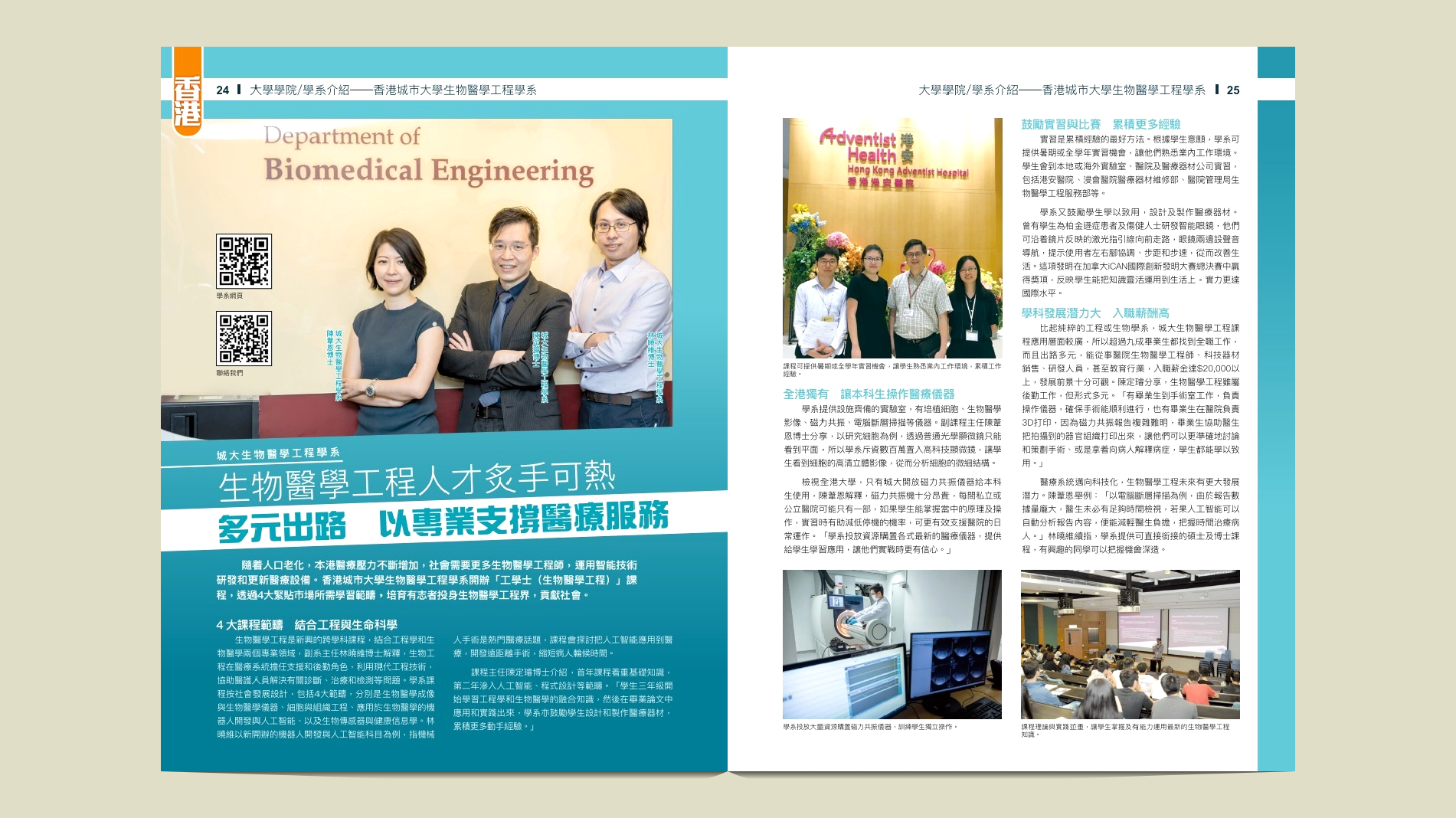
Department of Biomedical Engineering

The Department of Biomedical Engineering (BME) aims to provide world-class education and to conduct research in emerging fields of engineering. To achieve these aims, the Department adopts an interdisciplinary approach and includes subject areas that ensure our graduates are equipped to meet Hong Kong's current and future needs. The Department ranked 46th in the world in the subject of biomedical engineering in the Academic Ranking of World Universities in 2024.

The Department currently offers a major in Biomedical Engineering. The Department’s faculty members have interdisciplinary backgrounds with academic strengths in areas including (a) bioMEMS; (b) bioimaging; (c) flexible bioelectronics; (d) biomedical robotics; and (e) nanomedicine / biomaterials.

Please refer to the Department's website for more information about the BME Department.

生物醫學工程學系旨在提供世界級的跨學科課程和教育,以培養可綜合工程技術與生命科學從而促進人類健康的卓越人才。本學系在世界大學學術排名 (Academic Ranking of World Universities) 當中的生物醫學工程學科排名位於全球第46名。因應香港和世界各地日益增加的人才需求,本系畢業生能夠應用跨學科知識服務於多個領域,如醫療器械、醫學診斷與治療技術、醫藥開發、公共健康、食物安全、生物安全測量、以及各類與生物醫學工程技術有關的行業。學系課程按社會發展設計,包括5大範疇,分別是生物醫學微機電系統、生物醫學成像、柔性生物電子學、生物醫學機械人、以及納米醫學/生物材料學。

Why BEng Biomedical Engineering?

Healthcare is one of the fastest-developing fields. Air and chemical pollution in modern city, fast spreading of infectious diseases, cancer, aging-related obesity, diabetes, and Alzheimer disease, all impose enormous pressure threating our health and quality of life. However, because of many challenges ahead in this dynamic field, it requires a discipline which can integrate the knowledge of engineering and life sciences at the intersection for medical solutions and innovations.

Hong Kong government clearly identifies medical and testing/certification services being among the six industries which Hong Kong has clear advantages for further development. Considerable amount of job opportunities will be created locally and globally. Aligned with this, Biomedical Engineering will serve to educate the future professionals, ultimately positioning Hong Kong to become a major centre in the following areas:

  • New biomedical devices for diseases diagnosis, monitoring, surveillance, and therapeutic treatment
  • Food safety and bio-security
  • New drug discovery
Our Target

This major aims to pursue excellence in education, research and innovation through the fusion of engineering with life sciences for the advancement of human health. The objectives of the major are to provide integrative educational opportunities that allow students to learn passionately, think critically and independently and innovate creatively so that they are:

  1. able to apply their skills to a variety of challenges in their chosen field;
  2. equipped with the spirit of innovation, creativity, adaptability and critical thinking to solve problems in biomedical engineering-related professions;
  3. able to function effectively in multidisciplinary team environments and communicate with a variety of audiences;
  4. able to demonstrate competency in their chosen fields, and make decisions that are socially and ethically responsible; and
  5. able to build and expand upon their undergraduate foundations by engaging in learning opportunities throughout their careers.
Start Your Career Here

As a graduate, you will find career opportunities in the medical device industry, engineering services in hospitals, consultation for public health, regulation and management in government departments and laboratories, and research and development in the commercial and educational sectors. Alternatively, you might choose to pursue postgraduate studies locally or overseas. This major will provide you with the expertise required to meet the needs of increasing public concern and demands on medical diagnostics and therapeutic treatments, biomedical instruments, food safety and quality, advancement in pharmaceutical and health maintenance products, as well as an awareness of human health and wellness.

Entrance Requirements
JUPAS Applicants

JUPAS Entrance Requirements

JS1211 BEng Biomedical Engineering (Features: Medical Technology / Bioinstrumentation / Cell and Tissue Engineering / Biomedical Robotics)
HKDSE SubjectMinimum Level Required
English LanguageLevel 3
Chinese LanguageLevel 3
MathematicsLevel 2
Citizenship and Social DevelopmentAttained
Elective 1Level 3 in one elective subject from: 
- Biology 
- Chemistry 
- Physics
Elective 2Level 3

Notes:  
- Besides Category A elective subjects, Mathematics extended modules (M1/M2) and “other languages” can also be used to meet the elective requirement. If students take both M1 and M2, they are counted as one subject only.  
- Applied Learning subjects are not counted as elective subjects.  
- For details of the alternative Chinese Language qualifications acceptable by the University for Non-Chinese Speaking (NCS) students, please click here.

Direct/Non-JUPAS Applicants

Direct/ Non-JUPAS Applicants Entrance Requirements

To be considered for admission, you must satisfy the General Entrance Requirements. Applicants are also expected to have a science or engineering background.

Local applicants with HKDSE English Language below Level 3 are required to have a minimum TOEFL score of 550 (paper-based test) or 79 (Internet-based test), an IELTS overall band score of 6.5, or equivalent.

Curriculum Structure

For details of the programme’s curriculum structure, please visit the 'Undergraduate Catalogue'.

What You Will Be Studying

The curriculum has been categorised into four main areas:

Technical Foundation courses

Artificial Intelligence in Biomedical Engineering, Mathematics for Biomedical Engineering, Electrical Principles, Biological Thermofluids, Biomechanics, Materials for Biomedical Engineering, Electromagnetics, Engineering Graphics, Engineering Computing

Medical Devices and Systems

Medical Biotechnology in Imaging and Measurement, Biomedical Signals and Systems, Micro and Nanotechnology, Computational Biology and Bioinformatics, Biomedical Instrumentation, Bio-sensors and Bio-devices, Biomedical Systems and Control, Biomedical Devices for Digital Medicine

Cell and Molecular Engineering

Cellular and Biomolecular Engineering, Cell Transport and Signalling, Tissue Engineering, Regenerative Medicine, Gene Therapy

Health and Wellness Technology

Human Quantitative Physiology, Robotic Technology in Healthcare, Bio-safety and Risk Assessment, Technology for Drug Discovery, Radiotherapy Physics

Industrial Training and International Exchange

The University and the Department offer work placement opportunities through various internship schemes, which provide students with full-time job attachments not only in Hong Kong hospitals and firms, but also in those of the Pearl River Delta region and overseas. Through such placements, students will:

  • gain solid experience in real-world work environments;
  • develop problem-solving abilities and interpersonal skills;
  • learn the right attitudes towards work and professionalism; and
  • broaden their experience and enhance their employability.

Students in the department can also opt for technical final year projects offered by companies, under the joint supervision of a BME faculty member and a company mentor.

The University offers a number of credit-bearing exchange programmes for students with various partner institutions all around the world. Through these, students can broaden their educational horizons, gain language experience and enhance their awareness of different cultures.

Please visit CityUHK's website for details of outbound exchange programmes.

Professional Recognition

This major has been granted accreditation by the Hong Kong Institution of Engineers (HKIE), a signatory member of the Washington Accord under which all members agree to recognise each other’s accredited Engineering degree programmes.

Undergraduate plus Master's Degree Programme

Eligible students will be invited to apply for the “Undergraduate plus Master's Degree Programme” offered by the Department. Students in an “Undergraduate plus Master's Degree Programme” will receive a conditional offer for a Master's degree programme when they join CityUHK as undergraduate students. They can benefit from higher-level courses, including those with research elements and normally taught at the postgraduate level, during their undergraduate study. They will be awarded the Bachelor of Engineering in Biomedical Engineering (BEngBME) and Master of Science in Biomedical Engineering (MSBME) degrees upon completion of the programme.

Please visit CityUHK’s website and the Department’s website for details of the Programme.

Did You Know?

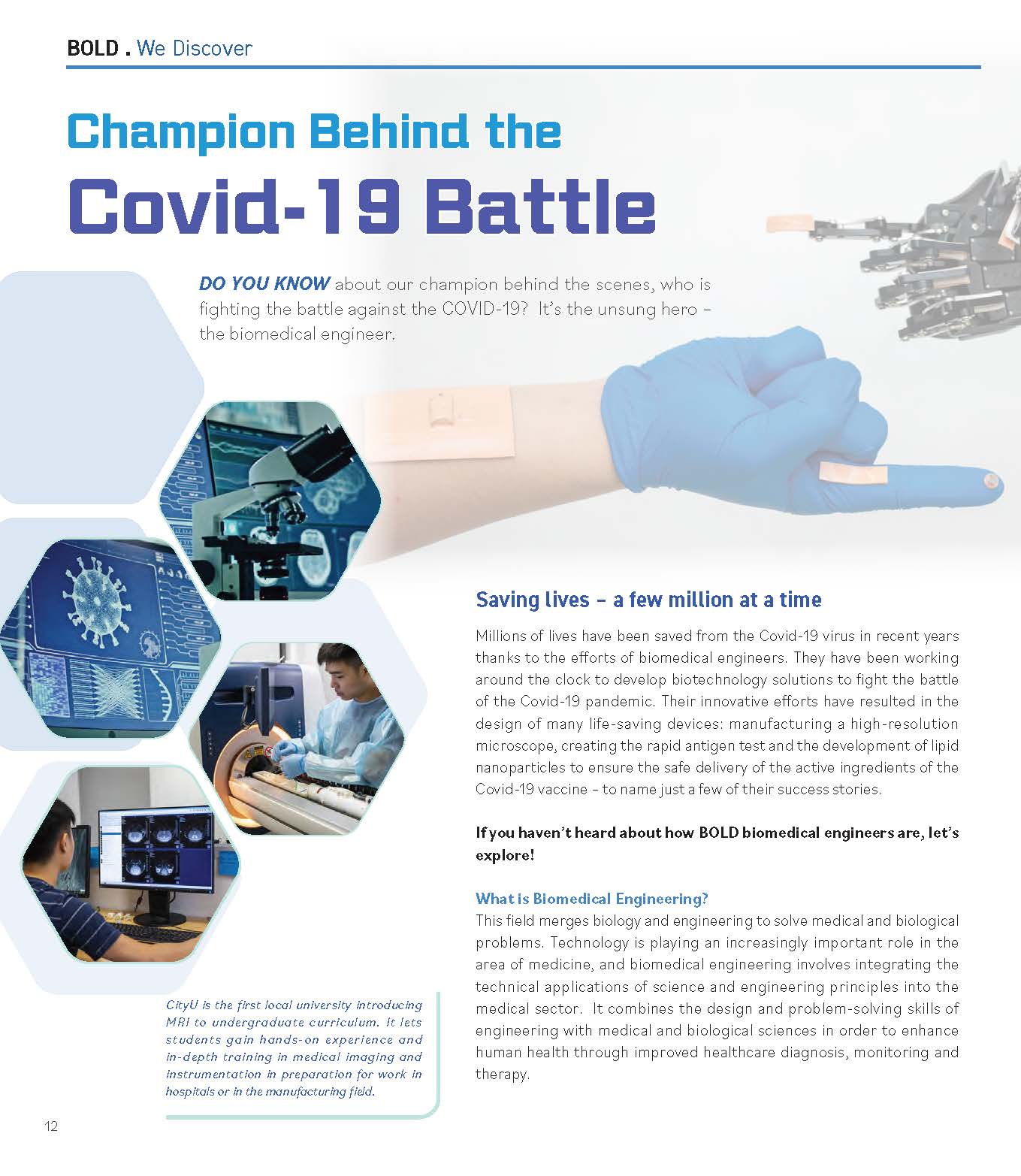
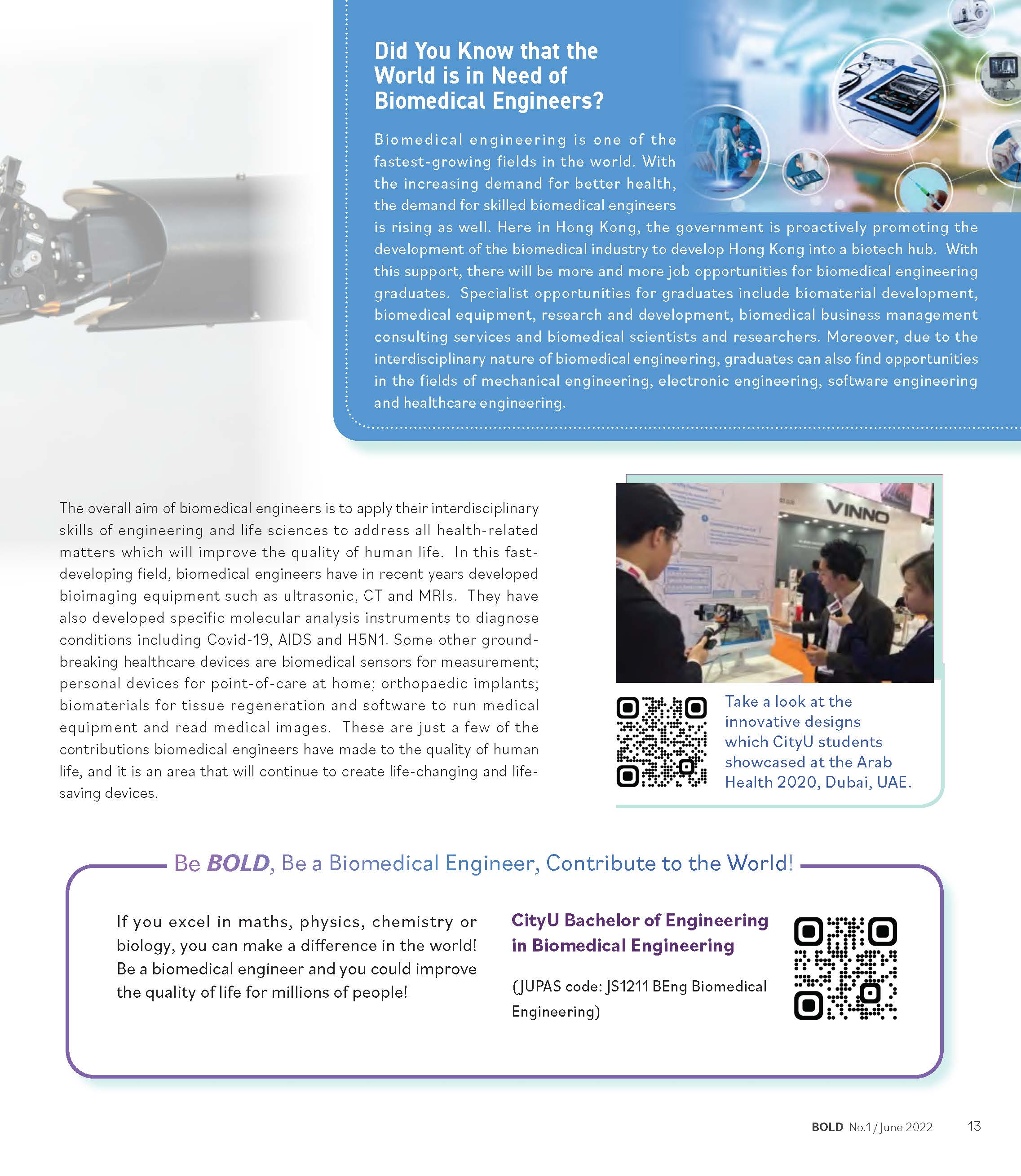
The world is currently suffering from the effects of the coronavirus disease 2019 (COVID-19) pandemic. Biomedical engineering is a major player in the fight against COVID-19, including the development of biomaterials for vaccines, devices for rapid tests, and image technology for diagnosis and treatment.

Over 400 million people in China, 31% of the population, will be over 60 years old by 2050 (www.chinadaily.com.cn). In addition, air and chemical pollution, threats to bio-security, obesity and the rapid spread of infectious diseases will continue to impose enormous pressures on the provision of trained professionals in the field of biomedical engineering.

The Hong Kong government has clearly identified medical and testing/certification services as among the six industries with clear advantages for further development. The Biomedical Engineering major will educate future professionals in these industries.

本課程旨在為香港及大中華地區培育生物醫學工程專業人才,畢業生將具備跨學科專業技術及國際視野,以應付人口老化及疾病對人類健康帶來的挑戰。

Interview Articles and Publications
CityUHK BOLD Magazine Issue No. 1
Education Media
Programme Video
生物醫學工程 多元出路 成就未來
年輕畢業生盼以所學造福人群
生物醫學工程學什麽?
生物醫學工程的應用:電子皮膚
醫院內的「解決專員」:生物醫學工程師
打針又關工程學的事!?
Programme Brochure
Contact Value
Admission Year
Programe A-Z
author_college
Title (For sorting)
101
Programme Calculation Method
Best 5 Subjects
Non-JUPAS Year 1 Admission
Non-JUPAS Senior Year Admission
International Admission
Mainland Non-Gaokao Admission
Deadline applicable to all types of Admission
Historical Data
Interview Arrangement - Direct Yr1

When necessary
- March to July 2026
- Individual interview
- English 

Interview Arrangement - JUPAS

When necessary

Late Application (Deadline applicable to all types)
Off
Late Application (International Admission)
Off
Late Application (Mainland Non-Gaokao Admission)
Off
Late Application (Non-JUPAS Senior Year Admission)
Off
Late Application (Non-JUPAS Year 1 Admission)
Off
Maths Core / M1 / M2 Calculation as one Subject
On
Minimum Entrance Requirement (Core)
Historical Data Display
On
Reduce the font size?
On
专业名称
1211 工学士(生物医学工程)
专业副标题
特点: 医疗技术 / 生物仪器 / 细胞和组织工程 / 医疗机器人
指定选考科目
物理、化学、生命科学/生物其中两科
文理科要求
理科

BEng Materials Science and Engineering (Features: HKIE Accredited / Industrial and Research Internships / Overseas Double-degrees / Knowledge Transfer / World-leading Research)

College/School
Subtitle
工學士(材料科學及工程) (特點: 香港工程師學會認可 / 工業和科研實習 / 海外雙學位課程 / 知識到應用遷移 / 世界領先的研究
Thumbnail
Image
MSE admission 202627
Academic Year of Entry
Admission Code

1210 (JS1210)

Indicative Intake Target

Local Places:

24 (For First-Year Entry)*


Non-Local Places 
(All CityUHK programmes except Mainland Gaokao):

Around 500

Normal Duration of Programme
4 years
Programme / Major Leader
Prof. Stephen TSANG

PhD University of Toronto, Canada

+852 3442 4618

Remarks

* for JUPAS and non-JUPAS admissions

Why BEng Materials Science and Engineering?

The comfort and convenience of modern life are intimately associated with the discovery, manipulation, and selection of natural and synthetic materials. Advancements in materials science and engineering (MSE) have led to a better understanding and manipulation of materials, which is a prerequisite for future technological processes.  

Our MSE program aims to nurture students to become material experts and contribute to the fast-growing high-tech industry. Besides a broad selection of expertise in construction materials, bio-materials, and energy materials, our program also offers training for students on Artificial Intelligence (AI) assisted material development. There are also various opportunities where the students can gain hands-on experience through research and industrial internship schemes and strengthen their portfolios during their studies.

Join us to Make Something Extraordinary!

Entrance Requirements
JUPAS Applicants

JUPAS Entrance Requirements

JS1210 BEng Materials Science and Engineering (Features: HKIE Accredited / Industrial and Research Internships / Overseas Double-degrees / Knowledge Transfer / World-leading Research)
HKDSE SubjectMinimum Level Required
English LanguageLevel 3
Chinese LanguageLevel 3
MathematicsLevel 2
Citizenship and Social DevelopmentAttained
Elective 1Level 3 in one elective subject from: 
- Chemistry 
- Design and Applied Technology 
- Physics
Elective 2Level 3

Notes:  
- Besides Category A elective subjects, Mathematics extended modules (M1/M2) and “other languages” can also be used to meet the elective requirement. If students take both M1 and M2, they are counted as one subject only.  
- Applied Learning subjects are not counted as elective subjects.  
- For details of the alternative Chinese Language qualifications acceptable by the University for Non-Chinese Speaking (NCS) students, please click here.

Direct/Non-JUPAS Applicants

Direct/ Non-JUPAS Applicants Entrance Requirements

To be considered for admission, you must satisfy the General Entrance Requirements. Applicants are also expected to have a science or engineering background.

Curriculum Structure
Gateway Education

GE English/EAP (6 credit units) *

  • GE English (1): GE 1401 University English (3 credit units)
  • GE English (2): GE 2410 English for Engineering (3 credit units)

*Students scoring below Level 4 in HKDSE English Language or Grade D in HKALE AS-level Use of English or students who do not possess an equivalent qualification are required to complete two 3-credit unit courses, prior to taking the GE English courses. Students who demonstrate that they have achieved a grade B or above in their overall course results for ELA0200A will achieve 3 credits and also be considered to have satisfied the pre-requisite for entry to the GE English courses without needing to take ELA0200B.

College Specified GE Courses (9 credit units)

  • MA1200/MA1300 (3 credit units) 
    Calculus and Basic Linear Algebra I/ 
    Enhanced Calculus and Linear Algebra I
  • MA1201/MA1301 (3 credit units) 
    Calculus and Basic Linear Algebra II/ 
    Enhanced Calculus and Linear Algebra II
  • MSE2006 Materials Engineers in Society

Any GE Courses (3 credit units)

  • GE1501 Chinese Civilization – History and Philosophy and/or GE courses from the distributional areas
College Required Courses

College Required Science Courses (6 credit units)

Choose two from the following science courses:

  • PHY1201 General Physics I (3 credit units)
  • CHEM1300 Principles of General Chemistry(3 credit units)
Department Required Courses

Department Required Courses (6 credit units)

  • CS1302 Introduction to Computer Programming
  • PHY1202 General Physics II
Department of Materials Science and Engineering

As the first of its kind in Hong Kong, the Department of Materials Science and Engineering was established to develop internationally competitive and cutting-edge research and provide a professional curriculum that equips graduates to contribute to various materials related sectors in Hong Kong, for the fast-growing high-tech industries.

The Department serves as a collaboration platform for developing cross-disciplinary academic programmes and interdisciplinary research projects with other academic units in the University. Further, it aspires to become a world-leading department in research and professional education with a focus on the following four target areas:

  • Biomaterials
  • Computational materials science 
  • Functional materials
  • Structural materials

The Department also serves as an international platform to encourage collaboration among the leading institutes in the world and to enhance our global research reputation.

BEng Materials Science and Engineering

In the Materials Science and Engineering major, students acquire knowledge that can be used to solve materials problems in engineering processes. Graduates of this major can seek jobs in engineering companies and join the Hong Kong Institution of Engineers as graduate members. They can become professional engineers after receiving the relevant on-the-job training and completing the professional assessment.

材料是技術發展的基礎,隨着各國對核心技術的重點發展,在本地以至國外對材料科學的人才需求將會大增。本課程旨在培育材料科學及工程的專業人才,以配合社會未來在基礎科技的發展。課程包括材料原理、表徵、設計、製造、以及應用等多方面專業範疇,並涵蓋金屬、半導體、生物、建築、能源、納米等重要材料。本課程着重經驗培訓及理論實踐,特設有與公司及科研機構合作的項目。提升學生將來就業機會。相關學歷不但符合香港工程師學會會員的申請資格,修業後亦可申請全額獎學金資助在本地或海外知名學府攻讀相關的碩士或博士課程。

Our Target

The Materials Science and Engineering major aims to equip students with the skills and knowledge required to meet local and regional needs in the industrial, commercial, government and education sectors.

In particular, graduates of this major understand the production, fabrication and service performance of engineering materials, including conventional bulk materials, advanced thin film and nanostructured materials. Working with other engineering specialists, our graduates contribute to the design, manufacture, maintenance, safety enhancement and testing of engineering components, devices, structures and processing plants.

Start Your Career Here

Materials Science and Engineering is an exciting and fascinating subject. Many of the novel materials invented over the past few decades significantly influence the way we live.

Materials Science and Engineering has permeated all industrial sectors. Graduates may choose to work in many different areas such as the electronics, toy, plastic, metal, ceramic and construction industries, or in testing laboratories. Graduates may also be employed as quality control engineers, production engineers, testing engineers or technical sales engineers for equipment, machinery and materials.

A materials science and engineering education predisposes students to a life enriched by the ability to understand technical information and analyse problems using scientific reasoning. In the past, materials science and engineering graduates have pursued successful careers in other diverse fields such as finance, business and education.

Industrial Training and International Exchange

The College of Engineering and the Department offer work placement opportunities through different internship schemes that provide students with full-time job attachments in firms in Hong Kong, the Pearl River Delta region, and overseas. Through such placements, students will:

Gain solid experience in a real-world work environment; develop problem-solving abilities and interpersonal skills; learn the right attitudes towards work and professionalism; and broaden their experience and enhance their employability.

For details, please visit the College’s Co-operative Education website.

To help students broaden their educational horizons, gain language experience and enhance their awareness of different cultures, the Department, College, and University offer over 110 credit-bearing exchange programmes with various partner universities around the world, including Australia, Canada, Europe, the US and others in the Asia-Pacific region.

For details, please visit the University’s outbound exchange programme website.

Professional Recognition

The Materials Science and Engineering major is the first and currently the only Materials Science and Engineering degree accredited by the Hong Kong Institution of Engineers.

Bonus Features

Graduates of the Materials Science and Engineering major are all-round materials engineers who can participate in design, manufacturing and quality assurance teams in high-tech industries.

Programme Video
Alumni Sharing
Materials Science in Our Daily Lives
Programme Brochure
Admission Year
Programe A-Z
author_college
Title (For sorting)
410
Programme Calculation Method
Best 5 Subjects
Non-JUPAS Year 1 Admission
Non-JUPAS Senior Year Admission
International Admission
Mainland Non-Gaokao Admission
Deadline applicable to all types of Admission
Included Subjects for calculation first
Historical Data
Interview Arrangement - Direct Yr1

On a selective basis
- When necessary
- Group interview
- English

Interview Arrangement - JUPAS

On a selective basis
- Mid-July 2026 
- Group interview 
- English

Late Application (Deadline applicable to all types)
Off
Late Application (International Admission)
Off
Late Application (Mainland Non-Gaokao Admission)
Off
Late Application (Non-JUPAS Senior Year Admission)
Off
Late Application (Non-JUPAS Year 1 Admission)
Off
Maths Core / M1 / M2 Calculation as one Subject
Off
Minimum Entrance Requirement (Core)
Historical Data Display
On
Reduce the font size?
On
专业名称
1210 工学士(材料科学及工程)
专业副标题
特点: 香港工程师学会认可 / 工业和科研实习 / 海外双学位课程 / 知识到应用迁移 / 世界领先的研究
指定选考科目
物理
文理科要求
理科

Mechanical Engineering (Majors: BEng Aerospace Engineering / BEng Mechanical Engineering / BEng Nuclear and Risk Engineering)

College/School
Subtitle
機械工程學 [主修: 工學士(航空航天工程) / 工學士(機械工程) / 工學士(核子及風險工程)]
Thumbnail
Image
MNE_new
Academic Year of Entry
Admission Code

1207 (JS1207)

Indicative Intake Target

Local Places:

87 (For First-Year Entry)*


Non-Local Places  
(All CityUHK programmes except Mainland Gaokao):

Around 500

Normal Duration of Programme
4 years
Admissions Tutor
Prof. Wei Yin MA
Deputy Admissions Tutor
Prof. Penghao DUAN
Deputy Admissions Tutor
Prof. Jack Hau Yung LO
Remarks

* for JUPAS and non-JUPAS admissions

Why Mechanical Engineering?

Mechanical Engineering is a highly popular degree programme that offers students a wide range of career opportunities. At City University of Hong Kong, we provide a comprehensive Mechanical Engineering programme designed to equip you with the essential skills and knowledge necessary to excel in any technology-related field. Our programme includes three majors, Aerospace Engineering, Mechanical Engineering, and Nuclear and Risk Engineering, offering students a range of options based on their interests. With an almost 100% employment rate, a degree in Mechanical Engineering from City University of Hong Kong ensures you a promising future with excellent job opportunities. Join us today and embark on your journey towards a successful career in Mechanical Engineering.

Entrance Requirements
JUPAS Applicants

JUPAS Entrance Requirements

JS1207 Mechanical Engineering (Majors: BEng Aerospace Engineering / BEng Mechanical Engineering / BEng Nuclear and Risk Engineering)
HKDSE SubjectMinimum Level Required
English LanguageLevel 3
Chinese LanguageLevel 3
MathematicsLevel 2
Citizenship and Social DevelopmentAttained
Elective 1Level 3 in one elective subject from: 
- Chemistry 
- Design and Applied Technology 
- M1/M2 
- Physics
Elective 2Level 3

Notes:  
- Besides Category A elective subjects, Mathematics extended modules (M1/M2) and “other languages” can also be used to meet the elective requirement. If students take both M1 and M2, they are counted as one subject only.  
- Applied Learning subjects are not counted as elective subjects.  
- For details of the alternative Chinese Language qualifications acceptable by the University for Non-Chinese Speaking (NCS) students, please click here.

Direct/Non-JUPAS Applicants

Direct/ Non-JUPAS Applicants Entrance Requirements

To be considered for admission, you must satisfy the General Entrance Requirements. Applicants are also expected to have a science or engineering background.

Admission Arrangements

Applicants to this programme (admission code: 1207) will be considered for admission to first-year studies at the Department of Mechanical Engineering. Students will enter a major (current major options: Aerospace Engineering, Mechanical Engineering, Nuclear and Risk Engineering) after one year of study. The top 40% of students# will have a free choice of majors offered by the Department. The other 60% of students will be allocated a major within the Department, subject to the availability of places and the selection criteria set by individual majors.

# based on CGPA with no failed grades and completion of at least 30 credit units including College/Department required courses


Applicants seeking advanced standing entry can submit an application for the following programmes:

Curriculum Structure

Subject Area

Course Code

Course Title

Credit Units

Gateway Education (12 credit units)


GE1401 & GE2410


LC0200A and/or LC0200B

(a) University English &  
Discipline Specific English  
- English for Engineering

OR English for Academic Purposes 1 and/or English for Academic Purposes 2     
(depending on students' language background)

6

GE1501

(b) Chinese Civilization - History and Philosophy

3

GE1601(c) Whole-Person Development1

-

(d) Gateway Education courses

3

College-specified Courses (9 credit units)

Mathematics

MA1200 / MA1300

Calculus and Basic Linear Algebra I / 
Enhanced Calculus and Linear Algebra I

3

MA1201 / MA1301

Calculus and Basic Linear Algebra II / 
Enhanced Calculus and Linear Algebra II

3

Engineering

MNE2066

Engineers in Society

3

College Requirement (6 credit units)

Computing

CS1302

Introduction to Computer Programming

3

Physics

PHY1101

Introductory Classical Mechanics

3

Department-specified Courses (3 credit units)

Engineering

MNE2116

Engineering Graphics

0

Physics

PHY1202

General Physics II

3


Total:

31


Remark: The above First-Year Curriculum is only applicable for students admitted into the four-year programme (1207).     
 

Department of Mechanical Engineering

The Department of Mechanical Engineering (MNE) aims to educate and train students to be professional engineers, providing them with broad-based knowledge and the fundamentals of mechanical and nuclear engineering, and the capability to integrate the diverse disciplines of mechanical, electronic and computer engineering. To achieve these aims, the Department takes an interdisciplinary approach and includes subject areas that ensure our graduates are equipped to meet Hong Kong's current and future needs.

The Department currently offers majors in Aerospace Engineering, Mechanical Engineering and Nuclear and Risk Engineering. It has over 25 faculty members, with academic strengths in four specific areas: (1) thermal-fluids; (2) design, mechanics and materials; (3) robotics, automation and control; and (4) nuclear and risk engineering.

Please refer to the Department's website for more information about the MNE Department.

機械工程學系旨在提供世界級的跨學科課程和教育,以滿足香港和鄰近地區日益增加的人才需求。學系提供航空航天工程工學士學位課程,機械工程工學士學位課程,以及核子及風險工程工學士學位課程。課程概要如下:

1. 航空航天工程: 課程旨在為學生提供廣泛的工程技能基礎。學生將能附合當前和不斷變化的航空航天工業的需求,例如智能製造, 智能檢測, 超音速飛行, 太空飛行,下一代飛機(例如無人飛行器, 仿生飛行器, 電動飛機等)。此外,跨學科教育亦促進畢業生在技術服務、諮詢、製造和金融等領域的就業機會,以配合香港的人力需求。

2. 機械工程: 課程旨在提供一個集教育、創新科技與研究的全面課程。畢業生能夠應用機械工程知識作出專業剖析和判斷,應用於廣泛領域如材料開發、系統分析、自動化工程和微納米科技等。

3. 核子及風險工程: 課程旨在為核子和風險工程領域培養出具備多門學科知識的卓越人才,包括低碳發電、醫療和風險工程。畢業生可從事核電行業、材料工程、核醫學、輻射防護、環境保護、核放射設備、金融業風險評估和災害管理等相關專業工作。

Programme Video
Brief Introduction of BEng Aerospace Engineering Programme 工學士(航空航天工程)課程簡介
Brief Introduction of BEng Mechanical Engineering Programme 工學士(機械工程)課程簡介
Brief Introduction of BEng Nuclear and Risk Engineering Programme 工學士(核子及風險工程)課程簡介
Climate Change and Nuclear ​氣候變化與核能
城大機械工程實驗室
MNE Laboratories
Programme Brochure
Contact Type
Email
Contact Value
Admission Year
Programe A-Z
author_college
Title (For sorting)
407
Programme Calculation Method
Best 5 Subjects
Non-JUPAS Year 1 Admission
Non-JUPAS Senior Year Admission
International Admission
Mainland Non-Gaokao Admission
Deadline applicable to all types of Admission
Included Subjects for calculation first
Historical Data
Interview Arrangement - Direct Yr1

When necessary
- January to May 2026
- Individual interview
- English 

Interview Arrangement - JUPAS

When necessary

Late Application (Deadline applicable to all types)
Off
Late Application (International Admission)
Off
Late Application (Mainland Non-Gaokao Admission)
Off
Late Application (Non-JUPAS Senior Year Admission)
Off
Late Application (Non-JUPAS Year 1 Admission)
Off
Maths Core / M1 / M2 Calculation as one Subject
Off
Minimum Entrance Requirement (Core)
Historical Data Display
On
Reduce the font size?
On
专业名称
1207 机械工程学
专业副标题
主修: 工学士(航空航天工程) / 工学士(机械工程) / 工学士(核子及风险工程)
指定选考科目
物理、化学
文理科要求
理科